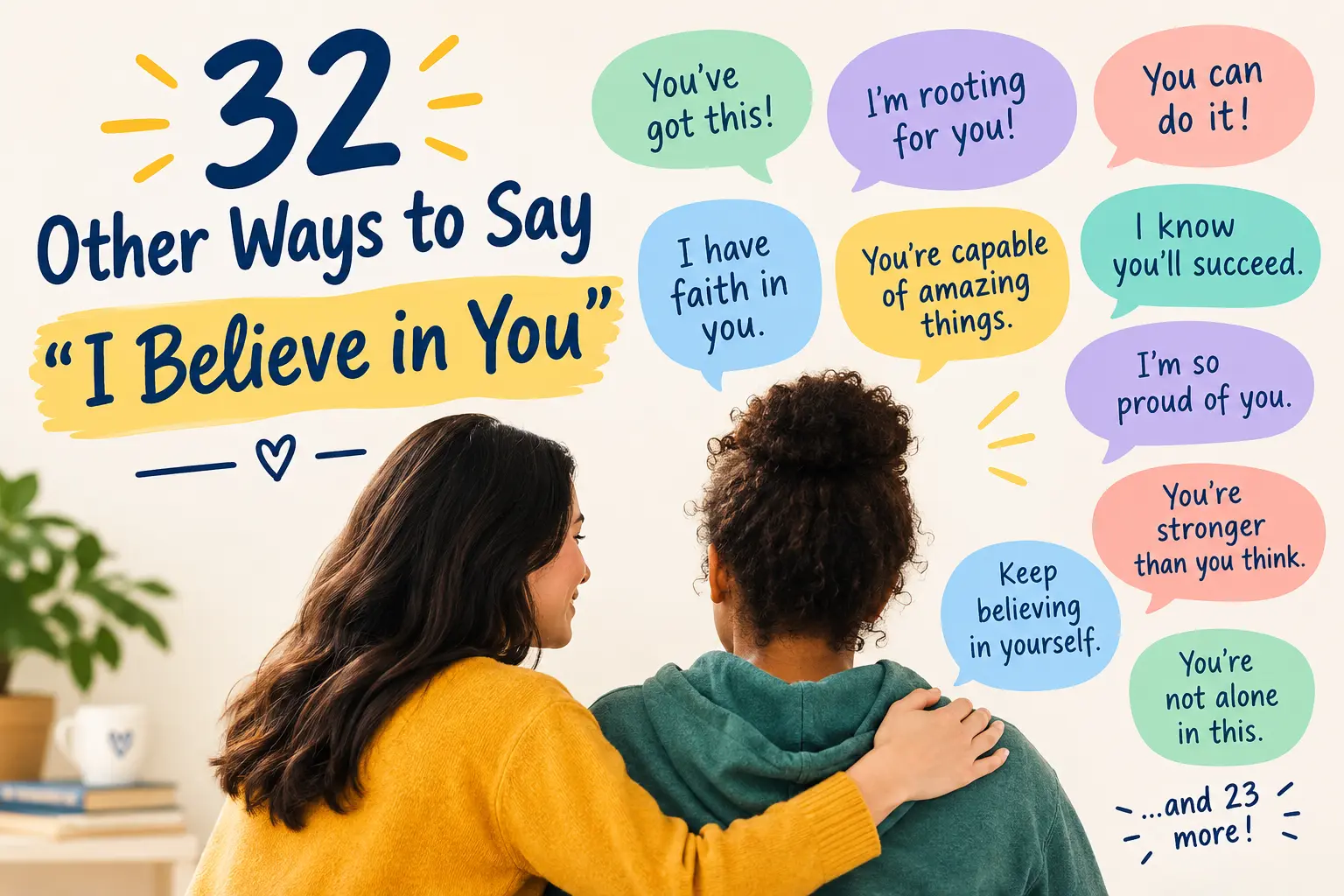

Sometimes, the simplest words can give someone the confidence they need to keep going. “I believe in you” is a powerful way to show trust, encouragement, and confidence in another person, but using different expressions can make your message feel more personal and natural.
Knowing 32 other ways to say “I believe in you” is especially useful when you want to avoid repeating the same phrase. Students, professionals, teachers, friends, family members, and ESL learners can use these alternatives to express encouragement in conversations, emails, messages, speeches, and social media posts.
When Should You Use These Alternatives?
The right alternative depends on your relationship with the person, the situation, and the tone you want to create.
- Casual conversations: Use warm and natural phrases when encouraging a friend, sibling, classmate, or someone close to you.
- Professional situations: Choose respectful expressions when supporting a colleague, employee, client, or professional contact.
- Academic writing: Use more structured language when discussing confidence, potential, achievement, or encouragement in an academic context.
- Emails and messages: Match the wording to your relationship with the recipient and the seriousness of the situation.
- Social media posts: Short, positive expressions work well for celebrating someone’s progress, achievement, or personal growth.
- Public speaking: Choose memorable and encouraging language that sounds confident when spoken aloud.
⚠️ Warning: Not every alternative works in every situation. Very casual expressions may sound inappropriate in formal communication, while overly formal phrases can feel distant when you’re talking to a close friend.
32 Other Ways to Say “I Believe in You”
1. I Know You Can Do It
Meaning / Definition
This phrase means you are confident that someone has the ability to succeed. It gives the person reassurance when they may be feeling uncertain.
Usage
It is commonly used in casual and semi-formal conversations with friends, family, students, or coworkers. The phrase has an encouraging and supportive tone rather than a formal one.
💡 Tip
Use this when someone needs a quick confidence boost before an important task.
Examples
- You have prepared for this exam for weeks, and I know you can do it.
- Don’t worry about the presentation—I know you can do it.
- You’ve worked hard to reach this point, so I know you can do it.
- Take a deep breath and give it your best shot; I know you can do it.
2. You’ve Got This
Meaning / Definition
“You’ve got this” means you are confident that someone can handle a challenge successfully. It communicates encouragement in a short, positive way.
Usage
This is a casual expression that works especially well in conversations, texts, and social media messages. It is less suitable for highly formal professional or academic writing.
💡 Tip
Use it when you want your encouragement to sound energetic and friendly.
Examples
- Your interview starts in ten minutes, but you’ve got this!
- Keep going with that project—you’ve got this.
- You’ve trained for months for this race, so you’ve got this.
- Whatever happens tomorrow, remember that you’ve got this.
3. I Have Faith in You
Meaning / Definition
This phrase means you trust someone’s abilities, judgment, or character. It can express deeper and more personal confidence than a simple statement of encouragement.
Usage
It can be casual, semi-formal, or emotional depending on the context. It is appropriate when supporting someone through an important decision, challenge, or period of growth.
💡 Tip
Use this phrase when you want your encouragement to sound sincere and heartfelt.
Examples
- I have faith in you, even when you don’t have faith in yourself.
- Your decision is yours to make, but I have faith in you.
- Keep working toward your goal because I have faith in you.
- I have faith in you to make the right choice for your future.
4. I Trust Your Abilities
Meaning / Definition
This phrase means you have confidence in someone’s skills and ability to complete a task. It focuses specifically on competence rather than emotion.
Usage
It is semi-formal and works well in professional, academic, and leadership settings. You can use it when assigning responsibility or reassuring someone about their capabilities.
💡 Tip
Choose this expression when you want your encouragement to sound professional.
Examples
- I trust your abilities, so I’m comfortable letting you lead the meeting.
- Your professor trusts your abilities and expects you to handle the research independently.
- I trust your abilities to manage this project successfully.
- You’ve demonstrated strong skills, and I trust your abilities.
5. I Know You’re Capable
Meaning / Definition
This phrase means you recognize that someone has the skills or potential to accomplish something. It reassures them that their abilities are real and valuable.
Usage
It is semi-formal and can be used with students, coworkers, friends, or family members. It works particularly well when someone is doubting themselves.
💡 Tip
Follow it with a specific reason when you want your encouragement to feel more convincing.
Examples
- I know you’re capable of handling this responsibility.
- Don’t let one difficult assignment make you forget that you’re capable.
- I know you’re capable of achieving much more than you realize.
- You’ve solved harder problems before, and I know you’re capable of solving this one too.
6. I Have Confidence in You
Meaning / Definition
This means you strongly trust someone’s ability to succeed or make good decisions. It directly communicates confidence without sounding overly emotional.
Usage
The phrase is semi-formal and works in both personal and professional situations. It is useful when you want to sound supportive while maintaining a mature tone.
💡 Tip
This is a versatile choice when you need an alternative that works in many settings.
Examples
- I have confidence in you and your ability to lead the team.
- Your preparation has been excellent, and I have confidence in you.
- I have confidence in you as you begin this new chapter.
- Even if the task seems difficult, I have confidence in you.
7. I Know You’ll Succeed
Meaning / Definition
This phrase expresses strong confidence that someone will achieve their goal. It focuses on the expected positive outcome.
Usage
It is semi-formal and suitable for conversations, cards, messages, and professional encouragement. Use it when someone is working toward a clear goal.
💡 Tip
Use it when you want your message to sound optimistic and certain.
Examples
- You’ve put so much effort into this project, and I know you’ll succeed.
- Keep studying consistently, and I know you’ll succeed.
- Your determination will take you far, and I know you’ll succeed.
- Whatever career path you choose, I know you’ll succeed.
8. You’re More Than Capable
Meaning / Definition
This phrase means someone has enough ability and skill to accomplish something successfully. It often reassures a person who is underestimating themselves.
Usage
It is casual to semi-formal and works well in spoken conversations and personal messages. It can also be appropriate in supportive workplace communication.
💡 Tip
Stress “more than” slightly when speaking to make the encouragement feel stronger.
Examples
- You’re more than capable of giving an excellent presentation.
- Don’t question yourself—you’re more than capable of completing this assignment.
- You’re more than capable of taking on this new role.
- With your experience, you’re more than capable of handling the situation.
9. I Know You Have What It Takes
Meaning / Definition
This expression means someone possesses the qualities, skills, or determination needed to succeed. It emphasizes potential and inner strength.
Usage
It is semi-formal and commonly used before competitions, interviews, exams, or major challenges. It sounds motivating without being overly emotional.
💡 Tip
Use it when you want to emphasize someone’s preparation and personal qualities.
Examples
- You’ve trained hard, and I know you have what it takes to win.
- Your experience shows me that you have what it takes to lead this project.
- I know you have what it takes to get through this difficult period.
- Walk into that interview confidently because you have what it takes.
10. I Trust You
Meaning / Definition
“I trust you” means you have confidence in someone’s judgment, decisions, or character. It can communicate both emotional support and personal confidence.
Usage
It is simple, casual, and powerful in personal conversations. In professional situations, it should be used when there is already a relationship of trust.
💡 Tip
Keep this phrase short when the person already understands the reason behind your confidence.
Examples
- It’s your decision, and I trust you.
- I trust you to handle the situation responsibly.
- You don’t need to explain everything—I trust you.
- Follow your instincts; I trust you.
11. I’m Confident in Your Abilities
Meaning / Definition
This phrase communicates professional confidence in someone’s skills and competence. It tells the person that you recognize their ability to perform successfully.
Usage
It is formal and particularly useful in workplace or academic settings. Managers, teachers, mentors, and supervisors can use it when giving encouragement.
💡 Tip
Pair it with a specific skill to make the statement more meaningful.
Examples
- I’m confident in your abilities as you take on this new assignment.
- After reviewing your work, I’m confident in your abilities.
- I’m confident in your abilities to manage the client relationship.
- Your preparation has been impressive, and I’m confident in your abilities.
12. I See Your Potential
Meaning / Definition
This phrase means you recognize that someone has the ability to develop, improve, or achieve something significant. It focuses on future possibilities.
Usage
It is semi-formal and often used by teachers, mentors, managers, and supportive friends. It is especially useful when someone is still developing their skills.
💡 Tip
Use it when encouraging growth rather than focusing only on immediate success.
Examples
- I see your potential, and I hope you keep developing your writing skills.
- Your first attempt wasn’t perfect, but I see your potential.
- Our manager sees your potential for a leadership position.
- I see your potential to build something meaningful from this idea.
13. You’re Going to Do Great
Meaning / Definition
This phrase tells someone that you expect them to perform well. It offers simple reassurance before an important event.
Usage
It is casual and natural in everyday conversations, texts, and messages. It is especially common before interviews, presentations, exams, and performances.
💡 Tip
Use it shortly before the event to provide immediate encouragement.
Examples
- Your audition is today, and you’re going to do great.
- Don’t overthink your presentation—you’ve practiced, and you’re going to do great.
- I can’t wait to see your first day at the new job; you’re going to do great.
- Good luck on your exam tomorrow. You’re going to do great!
14. I Know You’re Up to the Challenge
Meaning / Definition
This phrase means you believe someone has the ability and determination to handle a difficult situation. It presents the challenge as something they are prepared to face.
Usage
It is semi-formal and works well in professional, academic, and personal contexts. It is particularly useful when someone is facing a demanding task.
💡 Tip
Use it when you want to make a challenge sound achievable rather than frightening.
Examples
- This project is demanding, but I know you’re up to the challenge.
- The course will be difficult, but you’re up to the challenge.
- We’ve given you a big responsibility because we know you’re up to the challenge.
- Take the opportunity—you’ve got the experience, and you’re up to the challenge.
15. I Know You Can Handle It
Meaning / Definition
This phrase expresses confidence that someone can manage a difficult situation. It reassures them that they are strong or skilled enough to cope.
Usage
It is casual to semi-formal and works well in personal and workplace conversations. It can be especially comforting when someone feels overwhelmed.
💡 Tip
Say it calmly rather than forcefully if the person is already stressed.
Examples
- Things may feel overwhelming right now, but I know you can handle it.
- You’ve managed busy weeks before, and I know you can handle it.
- The new role comes with challenges, but I know you can handle it.
- Whatever happens during the meeting, I know you can handle it.
16. I Know You’ll Figure It Out
Meaning / Definition
This phrase means you trust someone to find a solution, even if they do not know exactly what to do yet. It emphasizes problem-solving ability.
Usage
It is casual and reassuring, making it ideal for conversations with friends, family, classmates, or trusted coworkers. It may sound too informal for highly formal writing.
💡 Tip
Use this when someone is facing uncertainty rather than a clearly defined task.
Examples
- You don’t need to have every answer today; I know you’ll figure it out.
- The software looks complicated, but I know you’ll figure it out.
- Give yourself some time to think—I know you’ll figure it out.
- Even if your first plan doesn’t work, I know you’ll figure it out.
17. I’m Rooting for You
Meaning / Definition
This means you are supporting someone and hoping they succeed. It creates a warm feeling of encouragement and personal support.
Usage
It is casual and commonly used in conversations, texts, cards, and social media. It is less appropriate for formal business writing.
💡 Tip
This phrase is excellent when you want to sound friendly and emotionally supportive.
Examples
- Good luck with your interview tomorrow—I’m rooting for you!
- I’m rooting for you as you launch your new business.
- Keep going with your training; everyone here is rooting for you.
- No matter how long it takes, I’m rooting for you.
18. I’m Behind You All the Way
Meaning / Definition
This phrase means you fully support someone’s efforts or decisions. It suggests ongoing encouragement rather than support for just one moment.
Usage
It is casual and emotional, making it suitable for close friends, family, and personal messages. It can sound too personal for some formal professional situations.
💡 Tip
Use it when you want to emphasize long-term support.
Examples
- If you decide to pursue your dream, I’m behind you all the way.
- Starting over won’t be easy, but I’m behind you all the way.
- Whatever career you choose, I’m behind you all the way.
- Keep building your business—I’m behind you all the way.
19. You Can Count on Me
Meaning / Definition
This phrase means the speaker will provide support and remain dependable. It combines encouragement with a promise of personal support.
Usage
It is casual to semi-formal and works well in personal and workplace relationships. Use it when you want to reassure someone that they do not have to face something alone.
💡 Tip
Use this when your support includes practical help, not just encouragement.
Examples
- If you need help preparing for the interview, you can count on me.
- Whatever happens with the project, you can count on me.
- Starting college can be stressful, but you can count on me whenever you need advice.
- If things become difficult, remember that you can count on me.
20. I Know You’re Going to Crush It
Meaning / Definition
This informal phrase means you are very confident that someone will perform extremely well. “Crush it” is a modern expression for doing something exceptionally successfully.
Usage
It is very casual and works best with friends, teammates, and younger audiences. Avoid it in formal academic or professional communication.
💡 Tip
Use this phrase when you want your message to sound energetic and enthusiastic.
Examples
- Your concert is tonight, and I know you’re going to crush it!
- You’ve practiced that presentation so many times—you’ll crush it.
- Good luck at the competition; I know you’re going to crush it.
- Walk into that interview with confidence because you’re going to crush it.
21. I Believe You Can Succeed
Meaning / Definition
This phrase directly communicates confidence in someone’s ability to achieve a goal. It is slightly more structured than the original “I believe in you.”
Usage
It is semi-formal and appropriate for academic, professional, and personal situations. It works particularly well when the desired outcome is clear.
💡 Tip
Mention the specific goal afterward when you want to make your encouragement more precise.
Examples
- I believe you can succeed if you continue studying consistently.
- Your idea has potential, and I believe you can succeed with it.
- I believe you can succeed in this new position.
- Even though the path may be difficult, I believe you can succeed.
22. You’re on the Right Track
Meaning / Definition
This phrase means someone is making progress in the right direction. It gives encouragement while acknowledging the work they have already completed.
Usage
It is semi-formal and especially useful in academic, professional, and coaching situations. It is less about predicting success and more about confirming positive progress.
💡 Tip
Add a specific observation when using this phrase as feedback.
Examples
- Your research is developing well, and you’re on the right track.
- You’ve improved your writing significantly; you’re definitely on the right track.
- The business plan needs some adjustments, but you’re on the right track.
- Keep practicing those speaking exercises—you’re on the right track.
23. I Know You Have Great Things Ahead
Meaning / Definition
This expression communicates optimism about someone’s future. It suggests that their abilities and effort can lead to positive opportunities.
Usage
It is warm and semi-formal, making it suitable for personal messages, graduation cards, farewell notes, and supportive conversations. It is more emotional than a typical professional statement.
💡 Tip
Use this when encouraging someone who is beginning a new stage in life.
Examples
- Graduation is only the beginning; I know you have great things ahead.
- You’ve learned so much from this experience, and I know you have great things ahead.
- Don’t let this setback define you—I know you have great things ahead.
- As you start your new journey, remember that you have great things ahead.
24. I See What You’re Capable Of
Meaning / Definition
This phrase means you recognize someone’s skills and potential based on what you have observed. It can reassure someone who does not yet recognize their own abilities.
Usage
It is casual to semi-formal and works particularly well when you have personally seen the person’s effort or performance. It can be used by friends, teachers, mentors, or managers.
💡 Tip
Mention something specific they accomplished to make the encouragement stronger.
Examples
- I’ve watched you improve over the past year, and I see what you’re capable of.
- You handled that difficult customer calmly, and now I see what you’re capable of.
- Your latest project showed me exactly what you’re capable of.
- You may doubt yourself sometimes, but I see what you’re capable of.
25. I’m Certain You Can Do It
Meaning / Definition
This phrase communicates a very high level of confidence in someone’s ability to succeed. It sounds stronger and more certain than simply saying you hope they succeed.
Usage
It is semi-formal and suitable for supportive conversations, professional encouragement, and written messages. Use it when you have good reason to be confident.
💡 Tip
Avoid using absolute certainty if the situation depends on factors outside the person’s control.
Examples
- You’ve prepared carefully, so I’m certain you can do it.
- With your experience, I’m certain you can manage this assignment.
- Take your time and stay focused; I’m certain you can do it.
- You’ve overcome bigger obstacles before, and I’m certain you can do it again.
26. I Know You’ll Rise to the Occasion
Meaning / Definition
This phrase means you believe someone will perform well when an important or difficult situation requires it. It highlights courage, adaptability, and competence.
Usage
It is semi-formal and works well in professional, academic, and personal situations. It is particularly appropriate before an important event or responsibility.
💡 Tip
This is a strong choice when someone is facing pressure or an unfamiliar responsibility.
Examples
- The conference will be challenging, but I know you’ll rise to the occasion.
- You’ve never led a team this large, but I know you’ll rise to the occasion.
- When the moment comes, I know you’ll rise to the occasion.
- This opportunity may feel intimidating, but I know you’ll rise to the occasion.
27. You Should Trust Yourself
Meaning / Definition
This phrase encourages someone to have confidence in their own judgment and abilities. It shifts the focus from the speaker’s belief to the person’s self-belief.
Usage
It is casual to semi-formal and works well when someone is struggling with self-doubt. It is especially natural in personal conversations and mentoring situations.
💡 Tip
Use it gently so that the message feels supportive rather than dismissive.
Examples
- You’ve considered every option carefully, so you should trust yourself.
- You know your subject better than anyone in that room, so trust yourself.
- Your instincts have helped you before; you should trust yourself this time too.
- You don’t need everyone’s approval—you should trust yourself.
28. Don’t Doubt Yourself
Meaning / Definition
This phrase tells someone not to lose confidence in their abilities. It is a direct way to encourage someone who is feeling uncertain.
Usage
It is casual and emotional, making it common in personal conversations, texts, and motivational messages. It can sound too direct in some professional contexts.
💡 Tip
Pair it with a positive reason so the message feels encouraging rather than commanding.
Examples
- You’ve worked too hard to doubt yourself now.
- Don’t doubt yourself just because the first attempt didn’t work.
- You’ve earned this opportunity, so don’t doubt yourself.
- When things become difficult, remember your progress and don’t doubt yourself.
29. You’re Stronger Than You Think
Meaning / Definition
This phrase tells someone that they have more strength or resilience than they realize. It encourages them to recognize their ability to overcome difficulties.
Usage
It is casual and emotionally supportive, making it appropriate for friends, family, and personal messages. It is not usually appropriate for formal business communication.
💡 Tip
Use this when someone is dealing with a setback or difficult period.
Examples
- This situation is painful, but you’re stronger than you think.
- You’ve already overcome so much, and you’re stronger than you think.
- Give yourself time to recover—you’re stronger than you think.
- One difficult day doesn’t define you; you’re stronger than you think.
30. Keep Going—I Know You Can
Meaning / Definition
This expression combines motivation with confidence in someone’s ability. It encourages them to continue instead of giving up.
Usage
It is casual and energetic, making it ideal for conversations, messages, sports, studying, and challenging projects. It is less appropriate for formal documents.
💡 Tip
Use it when someone is close to giving up or needs motivation to continue.
Examples
- The exam is almost over—keep going, I know you can.
- That final mile will be tough, but keep going; I know you can.
- The project is taking longer than expected, but keep going—I know you can finish it.
- You’ve made so much progress already, so keep going—I know you can.
31. I’m Confident You’ll Get There
Meaning / Definition
This phrase means you believe someone will eventually reach their goal. It focuses on progress and persistence rather than immediate success.
Usage
It is semi-formal and works well in personal, academic, mentoring, and professional conversations. It is especially useful when someone’s goal may take considerable time.
💡 Tip
Use “get there” when the goal is understood from the surrounding conversation.
Examples
- Your English is improving every month, and I’m confident you’ll get there.
- The business is still growing, but I’m confident you’ll get there.
- Keep learning at your own pace; I’m confident you’ll get there.
- You haven’t reached your target yet, but I’m confident you’ll get there.
32. I Know You Have It in You
Meaning / Definition
This phrase means you believe someone has the hidden strength, skill, or determination needed to succeed. It often encourages someone to recognize abilities they may be overlooking.
Usage
It is casual to semi-formal and works well in personal conversations, coaching, and motivational messages. It can sound especially powerful when someone is facing self-doubt.
💡 Tip
Use this phrase when you have seen enough of someone’s abilities to know they can do more.
Examples
- I’ve seen how hard you’ve worked, and I know you have it in you.
- Don’t give up on the competition yet—I know you have it in you.
- You may be nervous about leading the team, but I know you have it in you.
- Take one more step forward; I know you have it in you to finish strong.
Bonus Section — Short Text Messages
Short messages can sometimes provide the most meaningful encouragement, especially when someone needs support quickly. These ready-to-use options are natural for texting, messaging apps, and social media.
- You’ve got this! Keep going.
- I know you can do it. Believe in yourself!
- I’m rooting for you every step of the way.
Don’t doubt yourself—you’ve got what it takes. - Keep pushing forward. I know you’ll get there!
- Whatever happens, I’m always behind you.
Final Tips — How to Choose the Right Phrase
Choosing the right alternative is not only about vocabulary; the relationship, setting, and emotional situation also matter.
- Consider the setting: Use casual expressions with friends and family, and choose more professional wording at work or school.
- Know your audience: Think about how well you know the person before using an emotional or highly personal phrase.
- Match the formality: “You’ve got this” is casual, while “I’m confident in your abilities” is more formal.
- Spoken vs written: Some expressions sound natural aloud but may feel less suitable in formal emails or academic writing.
- Cultural sensitivity: Encouragement can be expressed differently across cultures, so avoid wording that could sound overly familiar or forceful.
- Emotional tone: Choose gentle language when someone is vulnerable and energetic language when they need motivation.
- Practice naturally: Learn several alternatives and use the one that fits the situation instead of forcing a phrase simply because it sounds sophisticated.