
Introduction
“Please find attached” is a familiar phrase, but using it in every email can make your writing sound repetitive or overly formal. If you regularly send documents, forms, reports, applications, or other files, having several natural alternatives can make your messages clearer and more polished.
In 2026, effective email communication is about being professional without sounding robotic. Knowing other ways to say “please find attached” can help students, professionals, job seekers, business owners, and ESL learners choose wording that fits the situation. Whether you are sending a resume to an employer or a report to a colleague, the right phrase can make your email sound more natural.
When Should You Use These Alternatives?
Different situations call for different levels of formality, so choose your wording based on the audience and purpose of your message.
- Casual conversations: Use relaxed phrases when sending a file to a friend, classmate, or familiar coworker.
- Professional situations: Choose clear and polished alternatives when communicating with clients, managers, customers, or business contacts.
- Academic writing: Use straightforward language when submitting assignments, research papers, applications, or supporting documents.
- Emails and messages: Select a phrase that clearly tells the recipient a file is included without unnecessary wording.
- Social media posts: Use shorter, conversational wording when sharing a document or resource through a professional or social platform.
- Public speaking: When referring to a document during a presentation or meeting, use natural spoken language rather than formal email wording.
⚠️ Warning: Avoid using overly casual expressions when emailing employers, professors, clients, government offices, or people you do not know well. Also, do not say a file is attached unless you have actually included it.
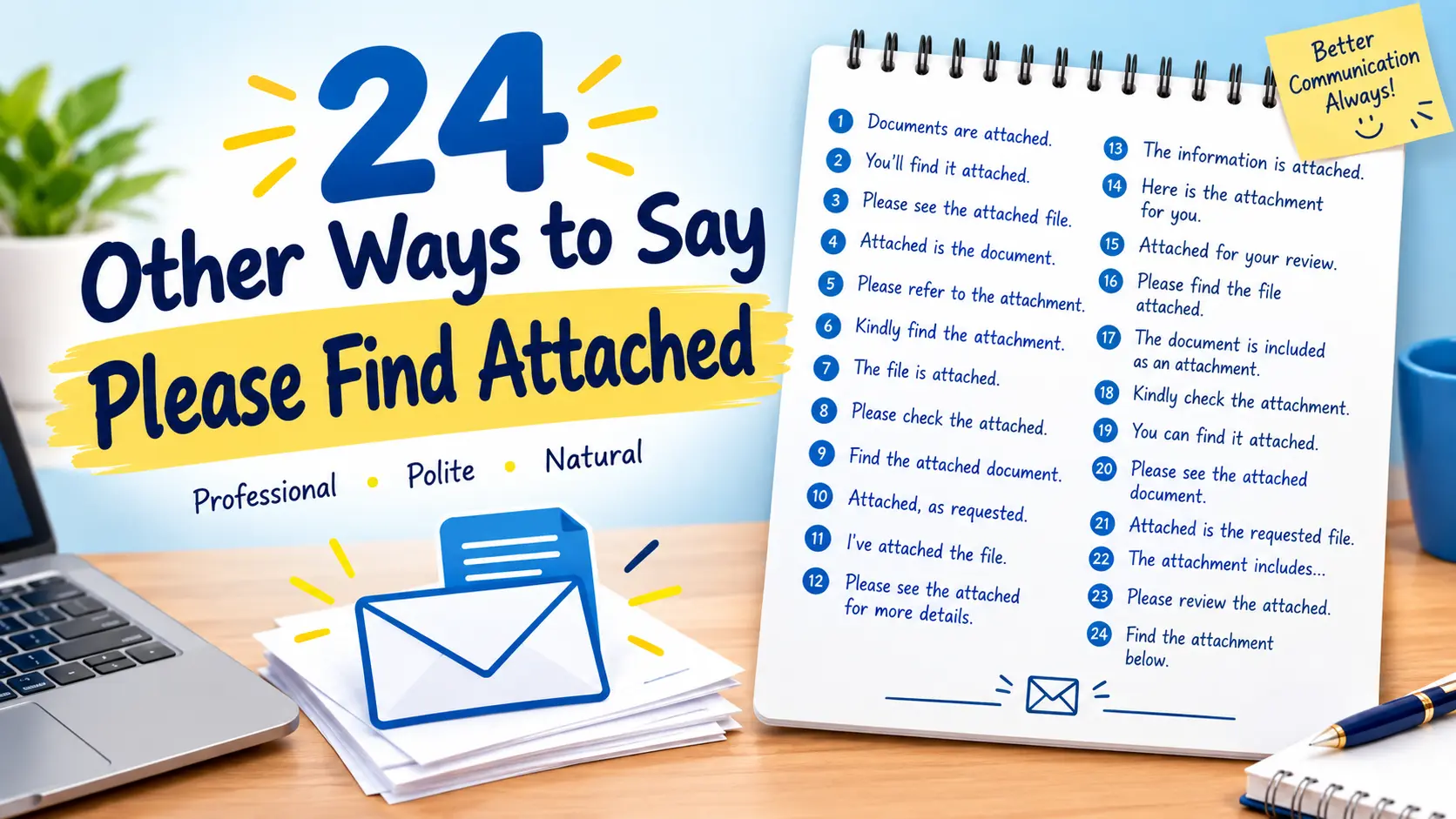
24 Other Ways to Say “Please Find Attached”
1. I’ve Attached the Document
Meaning / Definition
This phrase directly tells the reader that you included a document with your message. It is simple, clear, and easy to understand.
Usage
Use it in professional or semi-formal emails when you want to point out an attached file. It works especially well when the attachment is a specific document the recipient is expecting.
💡 Tip
Use the exact document name afterward if you want to make the email even clearer.
Examples
- I’ve attached the document for your review.
- I’ve attached the document you requested during our meeting.
- I’ve attached the document with the updated project details.
- I’ve attached the document containing my responses to your questions.
2. I’ve Attached the File for Your Review
Meaning / Definition
This phrase tells the recipient that a file is included and asks them to look through it. It has a professional and courteous tone.
Usage
Use it in semi-formal or formal business emails when you expect the recipient to examine the attachment. It is suitable for reports, proposals, spreadsheets, and other work-related files.
💡 Tip
This wording is particularly useful when you want the recipient to provide feedback.
Examples
- I’ve attached the file for your review before tomorrow’s meeting.
- I’ve attached the file for your review and comments.
- I’ve attached the file for your review and approval.
- I’ve attached the file for your review before we finalize the proposal.
3. Please See the Attached File
Meaning / Definition
This is a straightforward way to direct someone’s attention to an included file. It is slightly formal but still natural in modern professional communication.
Usage
Use this phrase in business, academic, or administrative emails. It is appropriate when the recipient needs to open the attachment to find additional information.
💡 Tip
For a warmer tone, combine it with a short explanation of why the file matters.
Examples
- Please see the attached file for the revised schedule.
- Please see the attached file for the complete list of participants.
- Please see the attached file for details about the new procedure.
- Please see the attached file for the information discussed earlier.
4. I’ve Included the File Below
Meaning / Definition
This phrase indicates that you have included a file with your message. It sounds natural and less formal than “please find attached.”
Usage
Use it in casual or semi-formal emails, especially when communicating with people you already know. It works well for routine workplace or personal correspondence.
💡 Tip
Make sure “below” accurately describes where the file appears in the message or email interface.
Examples
- I’ve included the file below for your reference.
- I’ve included the file below with the updated figures.
- I’ve included the file below so you can check the final version.
- I’ve included the file below along with the requested notes.
5. The Requested File Is Attached
Meaning / Definition
This phrase confirms that the file the recipient requested has been included. It is concise and professional.
Usage
Use it in formal or semi-formal emails when responding to a specific request. It is particularly useful for administrative, workplace, and customer-service communication.
💡 Tip
Mention the file’s name when you have multiple attachments.
Examples
- The requested file is attached for your records.
- The requested file is attached with the latest information.
- The requested file is attached to this email.
- The requested file is attached as a PDF for your convenience.
6. I’ve Included the Requested Document
Meaning / Definition
This phrase tells the recipient that you have provided the document they asked for. It sounds professional while avoiding unnecessary formality.
Usage
Use it in workplace, academic, or administrative emails. It is especially suitable when replying to a previous message or request.
💡 Tip
Use “document” when the attachment is a report, letter, form, or similar written material.
Examples
- I’ve included the requested document for your records.
- I’ve included the requested document with the updated information.
- I’ve included the requested document for your consideration.
- I’ve included the requested document in both Word and PDF formats.
7. The Document Is Attached for Your Reference
Meaning / Definition
This phrase tells the reader that a document is attached and may be useful for checking information. “For your reference” suggests that no immediate action may be required.
Usage
Use this formal or semi-formal expression when sharing background information, records, guidelines, or supporting documents. It is common in professional emails.
💡 Tip
Choose this phrase when you are providing information rather than specifically asking the recipient to respond.
Examples
- The document is attached for your reference.
- The updated policy is attached for your reference.
- The meeting notes are attached for your reference.
- The previous report is attached for your reference as you prepare the new proposal.
8. I’ve Attached the Report
Meaning / Definition
This is a direct way to tell someone that a report is included with your email. It avoids the formality of traditional attachment language.
Usage
Use it in professional and semi-formal emails when the attachment is specifically a report. It works well for project updates, financial information, research, and workplace documents.
💡 Tip
Replace “report” with the actual document type when appropriate.
Examples
- I’ve attached the report for your review.
- I’ve attached the report covering last month’s results.
- I’ve attached the report we discussed during the call.
- I’ve attached the report with the final recommendations.
9. You’ll Find the Document Attached
Meaning / Definition
This phrase tells the recipient where to find the document associated with the email. It has a polished but friendly tone.
Usage
Use it in semi-formal or professional emails when introducing an attachment. It is useful when you want something more conversational than “please find attached.”
💡 Tip
Add the document’s purpose to make the sentence more informative.
Examples
- You’ll find the document attached for your review.
- You’ll find the document attached with the updated project timeline.
- You’ll find the document attached to this message.
- You’ll find the completed application attached for your records.
10. The File You Requested Is Attached
Meaning / Definition
This phrase confirms that you have provided the exact file the recipient previously asked for. It is clear and professional.
Usage
Use it when replying to a request for a specific file. It is suitable for business, academic, customer-service, and administrative emails.
💡 Tip
Use this wording when you want to reassure the reader that you have addressed their request.
Examples
- The file you requested is attached for your review.
- The file you requested is attached to this email.
- The file you requested is attached in Excel format.
- The file you requested is attached with the corrected figures.
11. I’ve Enclosed the Document
Meaning / Definition
This phrase means that a document has been provided along with the message. “Enclosed” is more traditional and formal than “attached.”
Usage
Use it mainly in formal correspondence, particularly when referring to physical documents or formal written communication. In ordinary digital emails, “attached” usually sounds more natural.
💡 Tip
For a modern email, consider “I’ve attached the document” unless you intentionally want a traditional formal tone.
Examples
- I’ve enclosed the document for your consideration.
- I’ve enclosed the completed form with this letter.
- I’ve enclosed the requested information for your records.
- I’ve enclosed a copy of the agreement for your review.
12. Attached Is the Requested Document
Meaning / Definition
This is a concise and formal way to introduce an attachment. It puts emphasis on the document rather than the action of attaching it.
Usage
Use it in formal business, legal, academic, or administrative communication. It is appropriate when the recipient has requested a particular document.
💡 Tip
Because it is formal, avoid using it repeatedly in casual conversations.
Examples
- Attached is the requested document for your review.
- Attached is the requested copy of the agreement.
- Attached is the requested form, completed and signed.
- Attached is the requested report for your records.
13. I’ve Attached a Copy of the Document
Meaning / Definition
This phrase tells the reader that you have included a copy of a particular document. It is clear and professional.
Usage
Use it when the attachment is a copy rather than an original document. The phrase works well in formal and semi-formal emails.
💡 Tip
Use “a copy of” when the recipient might need to distinguish the attachment from an original version.
Examples
- I’ve attached a copy of the signed agreement.
- I’ve attached a copy of the receipt for your records.
- I’ve attached a copy of the updated contract.
- I’ve attached a copy of the certificate you requested.
14. I’ve Attached the Information You Requested
Meaning / Definition
This phrase tells the recipient that the information they asked for is included in an attachment. It focuses on the content rather than the file itself.
Usage
Use it in professional or semi-formal communication when responding to a question or information request. It works well with spreadsheets, reports, forms, and supporting documents.
💡 Tip
Use this phrase when the recipient cares more about the information than the format of the file.
Examples
- I’ve attached the information you requested regarding the project.
- I’ve attached the information you requested about the application process.
- I’ve attached the information you requested during our call.
- I’ve attached the information you requested for your review.
15. For Your Review, I’ve Attached the Document
Meaning / Definition
This phrase tells the reader that a document is attached and specifically invites them to review it. It sounds professional and purposeful.
Usage
Use it in formal or semi-formal emails when the recipient is expected to examine the attachment. It is useful for proposals, drafts, reports, and presentations.
💡 Tip
If you need a response, add a clear request after mentioning the attachment.
Examples
- For your review, I’ve attached the revised proposal.
- For your review, I’ve attached the latest draft of the report.
- For your review, I’ve attached the updated presentation.
- For your review, I’ve attached the final version of the agreement.
16. I’ve Attached the Relevant Documents
Meaning / Definition
This phrase indicates that you have included documents that relate directly to the subject of your email. It is useful when there is more than one attachment.
Usage
Use it in professional or formal emails when sharing several supporting files. It works well for applications, projects, business transactions, and administrative matters.
💡 Tip
If there are many files, name the most important ones so the recipient knows where to start.
Examples
- I’ve attached the relevant documents for your review.
- I’ve attached the relevant documents supporting my application.
- I’ve attached the relevant documents from our previous discussion.
- I’ve attached the relevant documents needed to complete the process.
17. Attached for Your Review
Meaning / Definition
This short phrase tells the recipient that something is attached and asks them to review it. It is concise and professional.
Usage
Use it in email messages when you want to avoid a long introductory sentence. It is generally semi-formal to formal.
💡 Tip
Use it with the document name for maximum clarity, such as “Updated proposal attached for your review.”
Examples
- The updated proposal is attached for your review.
- The draft contract is attached for your review.
- The presentation is attached for your review before Friday’s meeting.
- The completed application is attached for your review and approval.
18. Attached for Your Consideration
Meaning / Definition
This phrase tells someone that you have provided a document for them to think about or evaluate. It sounds more formal and deliberate than simply saying that a file is attached.
Usage
Use it in formal or professional situations involving proposals, applications, recommendations, or decisions. It is appropriate when you want the recipient to consider the contents carefully.
💡 Tip
Use this phrase when you want thoughtful consideration rather than simply asking someone to check a file.
Examples
- The proposal is attached for your consideration.
- I’ve attached my application for your consideration.
- The revised budget is attached for your consideration.
- I’ve attached the suggested changes for your consideration.
19. I’ve Attached the Requested Materials
Meaning / Definition
This phrase indicates that you have provided the materials requested by the recipient. “Materials” can refer to several types of files or resources.
Usage
Use it in professional, academic, or organizational communication when there may be multiple attachments. It has a semi-formal to formal tone.
💡 Tip
“Materials” works especially well when the attachments include different types of documents.
Examples
- I’ve attached the requested materials for your review.
- I’ve attached the requested materials for tomorrow’s workshop.
- I’ve attached the requested materials related to the training program.
- I’ve attached the requested materials, including the agenda and worksheets.
20. I’ve Included the Attachment
Meaning / Definition
This phrase points out that a file has been included with the email. It is simple and relatively neutral in tone.
Usage
Use it in casual or semi-formal workplace communication. It can be useful when the attachment has already been mentioned earlier in the conversation.
💡 Tip
When introducing an attachment for the first time, naming the file is usually clearer.
Examples
- I’ve included the attachment for your reference.
- I’ve included the attachment with the revised figures.
- I’ve included the attachment we discussed yesterday.
- I’ve included the attachment containing the completed questionnaire.
21. The Attached Document Contains the Requested Information
Meaning / Definition
This phrase tells the recipient both that a document is attached and what it contains. It provides more context than a basic attachment notice.
Usage
Use it in formal or semi-formal emails when the recipient needs specific information from the file. It is especially useful for reports, applications, and supporting documentation.
💡 Tip
Mentioning what the attachment contains can help the recipient decide whether they need to open it immediately.
Examples
- The attached document contains the requested information about the project.
- The attached document contains the requested financial details.
- The attached document contains the answers to your questions.
- The attached document contains the specifications for the proposed design.
22. I’ve Provided the Document as an Attachment
Meaning / Definition
This phrase clearly explains that the document has been supplied as an attached file. It has a professional and slightly formal tone.
Usage
Use it when communicating in business, academic, or administrative settings. It is helpful when you want to emphasize that the document has been formally provided.
💡 Tip
This wording can sound more official than necessary for a casual email, so use it when the context calls for professionalism.
Examples
- I’ve provided the document as an attachment for your review.
- I’ve provided the signed form as an attachment to this email.
- I’ve provided the requested report as an attachment.
- I’ve provided the supporting documents as attachments for your records.
23. Kindly See the Attached Document
Meaning / Definition
This phrase politely directs the recipient to an included document. It is formal and courteous, although “kindly” can sound somewhat traditional in modern English.
Usage
Use it in formal correspondence when a respectful tone is appropriate. It is more common in certain international varieties of business English than in everyday conversational English.
💡 Tip
For natural modern business English, “Please see the attached document” is often a smoother alternative.
Examples
- Kindly see the attached document for the requested details.
- Kindly see the attached document for the updated schedule.
- Kindly see the attached document and let me know if any changes are needed.
- Kindly see the attached document for additional information about the application.
24. I’ve Attached Everything You Need
Meaning / Definition
This phrase tells the recipient that all necessary files or information have been included. It sounds friendly, confident, and less formal than traditional attachment language.
Usage
Use it in casual or semi-formal emails when you have a familiar relationship with the recipient. It works particularly well when sending several documents at once.
💡 Tip
Avoid this phrase in highly formal situations unless you know the audience will appreciate its conversational tone.
Examples
- I’ve attached everything you need to complete the application.
- I’ve attached everything you need for tomorrow’s presentation.
- I’ve attached everything you need to get started on the project.
- I’ve attached everything you need, including the invoice and supporting documents.
Bonus Section — Polite Variations
If you want to sound courteous without repeating “please find attached,” these polite variations can make your emails feel more natural. They work especially well when you want to balance professionalism with a friendly tone.
- Please see the attached document for your review.
- I’ve attached the requested information for your convenience.
- You’ll find the relevant document attached to this email.
- I’ve included the requested files for your consideration.
- Please take a look at the attached document when you have a moment.
- I’ve attached the materials discussed in our previous conversation.
Final Tips — How to Choose the Right Phrase
The best alternative depends on your relationship with the reader, the purpose of the email, and how formal you want to sound.
- Consider the setting: Use relaxed wording with friends and familiar colleagues, but choose polished language for business, academic, or administrative communication.
- Know your audience: Think about who will read your message before choosing a phrase. A client or professor may expect more formal language than a close coworker.
- Match the formality: “I’ve attached the file” is natural and neutral, while “Attached is the requested document” sounds more formal.
- Spoken vs written: Traditional attachment phrases are designed for written communication. In conversation, simply say that you have sent or included the document.
- Cultural sensitivity: Some expressions, such as “kindly see the attached document,” are more common in certain varieties of international English. Choose wording that sounds natural for your audience.
- Emotional tone: Keep your wording warm when the situation calls for cooperation, but avoid excessive politeness that makes a simple email sound complicated.
- Practice naturally: The more alternatives you use in real emails, the easier it becomes to choose language that sounds confident, clear, and natural.