

Money is one of the most common words in everyday English, but repeating the same word can sometimes make your writing or conversation sound plain. Depending on the situation, you might want a casual expression, a professional alternative, a slang term, or a more polished phrase.
Learning other ways to say money can help you sound more natural and flexible in English. Some expressions work well in formal writing, while others are better suited to conversations with friends, social media posts, movies, or informal messages.
When Should You Use These Alternatives?
- Casual conversations: Use simple alternatives such as “cash,” “bucks,” or “dough” when talking with friends.
- Professional writing: Choose expressions such as “funds,” “financial resources,” or “capital” in business and workplace situations.
- Talking about income: Use “earnings,” “pay,” “salary,” or “wages” when discussing money received from work.
- Talking about wealth: Expressions such as “fortune,” “wealth,” or “assets” are more appropriate when referring to someone’s overall financial position.
- Creative writing: Slang and figurative expressions can make dialogue and storytelling feel more natural.
- Specific amounts: Words such as “cash,” “change,” or “bucks” may be useful when discussing physical or everyday spending money.
⚠️ Warning: Not every alternative means exactly the same thing as “money.” For example, “salary” means money earned from employment, while “capital” usually refers to money or assets used for investment or business purposes.
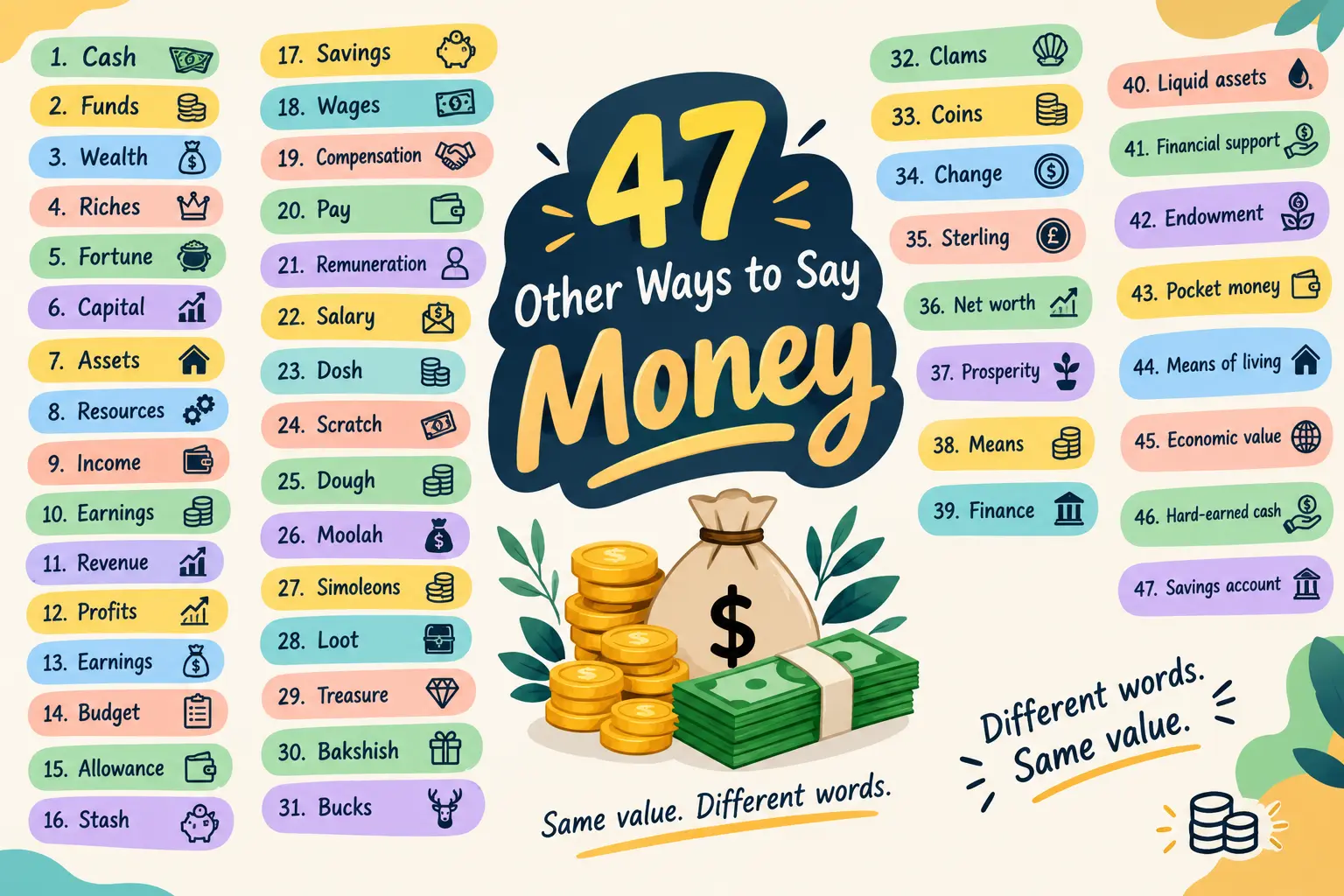
47 Other Ways to Say “Money”
1. Cash
Meaning / Definition: Cash refers to money in physical form, such as coins and banknotes. It can also casually mean money that is immediately available to spend.
Usage: “Cash” is common in everyday conversations and is less formal than “funds” or “financial resources.”
💡 Tip: Use “cash” when talking about spending money or paying for something.
Examples:
- I don’t have enough cash to pay for lunch.
- She always carries some cash with her.
- Do you have any cash on you?
- The store only accepts cash.
2. Funds
Meaning / Definition: Funds means money that is available for a particular purpose, activity, or expense.
Usage: This word is common in business, finance, organizations, and formal communication.
💡 Tip: Use “funds” when the money has a specific purpose.
Examples:
- We need more funds to complete the project.
- The company allocated funds for employee training.
- They raised funds for the new community center.
- I don’t have enough funds in my account.
3. Bucks
Meaning / Definition: “Bucks” is an informal American English word for dollars or money.
Usage: It is commonly used in casual conversations.
💡 Tip: “Bucks” sounds relaxed and conversational, so avoid it in formal business documents.
Examples:
- This shirt only cost me twenty bucks.
- I need a few bucks for the bus.
- How many bucks did you spend?
- He earns a few extra bucks on weekends.
4. Currency
Meaning / Definition: Currency refers to the money used in a particular country or economic system.
Usage: It is more precise and formal than simply saying “money.”
💡 Tip: Use “currency” when discussing different countries, exchange rates, or financial systems.
Examples:
- The local currency is the euro.
- You should exchange your currency before traveling.
- What currency do they use in Japan?
- The value of the currency has changed recently.
5. Wealth
Meaning / Definition: Wealth refers to a large amount of money, property, investments, or other valuable assets.
Usage: Use it when discussing someone’s overall financial position rather than everyday spending money.
💡 Tip: “Wealth” usually suggests accumulated financial resources.
Examples:
- He built his wealth through years of investing.
- The family has considerable wealth.
- Education can create opportunities for long-term wealth.
- She donated much of her wealth to charity.
6. Earnings
Meaning / Definition: Earnings are the money a person or business receives from work, investments, or commercial activity.
Usage: It is especially useful when talking about income or business performance.
💡 Tip: Use “earnings” when you want to emphasize money that has been earned.
Examples:
- Her earnings increased after she changed jobs.
- The company reported strong earnings.
- He saves part of his monthly earnings.
- His annual earnings depend on his sales.
7. Income
Meaning / Definition: Income is money received regularly from employment, business, investments, or other sources.
Usage: This is a neutral and widely used word in financial and everyday contexts.
💡 Tip: “Income” is especially useful when discussing how much money someone receives over a period.
Examples:
- Her monthly income is enough to cover her expenses.
- He has several sources of income.
- The new job provides a higher income.
- They are looking for ways to increase their income.
8. Revenue
Meaning / Definition: Revenue is the money generated by a business or organization, usually from selling goods or services.
Usage: It is primarily used in business and accounting.
💡 Tip: Don’t use “revenue” as a direct substitute for personal money.
Examples:
- The company’s revenue grew this year.
- Advertising generates significant revenue for the website.
- The business needs to increase its revenue.
- Online sales account for most of the company’s revenue.
9. Capital
Meaning / Definition: Capital refers to money or other financial resources available for investment, business operations, or growth.
Usage: It is common in economics, investing, and business discussions.
💡 Tip: Use “capital” when money is being used to create or expand something.
Examples:
- The company needs more capital to expand.
- She invested her capital in a small business.
- They raised capital from several investors.
- Limited capital made the project difficult to start.
10. Savings
Meaning / Definition: Savings refers to money that has been set aside rather than spent.
Usage: It is common when discussing personal finances and financial planning.
💡 Tip: Use “savings” when talking about money reserved for future needs.
Examples:
- I’m using my savings to buy a new car.
- She has built up her savings over several years.
- We need to protect our emergency savings.
- His savings helped him during a difficult period.
11. Pay
Meaning / Definition: Pay refers to money received for work or services.
Usage: It is common in everyday conversations about employment.
💡 Tip: “Pay” can refer to regular compensation rather than money in general.
Examples:
- The job offers good pay.
- I received my pay yesterday.
- Her pay increased after the promotion.
- The company provides competitive pay.
12. Salary
Meaning / Definition: Salary is a fixed amount of money paid regularly to an employee for their work.
Usage: Use it specifically when discussing employment compensation.
💡 Tip: “Salary” is not a general synonym for money.
Examples:
- She earns a good salary.
- His salary is paid monthly.
- They offered me a higher salary.
- She negotiated her salary before accepting the job.
13. Wages
Meaning / Definition: Wages are payments made to workers for their labor, often calculated hourly, daily, or weekly.
Usage: The word is common when discussing hourly or manual work.
💡 Tip: “Wages” often focuses on payment for labor rather than a fixed annual salary.
Examples:
- The workers asked for higher wages.
- His wages are paid every Friday.
- Minimum wages vary by location.
- Rising wages have affected the company’s costs.
14. Fortune
Meaning / Definition: Fortune can mean a very large amount of money or wealth.
Usage: It is often used in writing and storytelling when describing substantial wealth.
💡 Tip: “Fortune” usually suggests much more than ordinary spending money.
Examples:
- She made a fortune from her business.
- His family lost a large fortune.
- The invention earned him a fortune.
- Building a fortune takes time and discipline.
15. Dough
Meaning / Definition: “Dough” is an informal slang term for money.
Usage: It is mostly used in casual speech and informal writing.
💡 Tip: “Dough” has a playful, relaxed tone.
Examples:
- I need to save some dough this month.
- That car costs a lot of dough.
- He makes good dough from his business.
- We don’t have enough dough for that trip.
16. Moolah
Meaning / Definition: “Moolah” is an informal slang word meaning money.
Usage: It is playful and casual rather than professional.
💡 Tip: Use it for humorous or relaxed conversations.
Examples:
- I need some moolah before the weekend.
- That hobby requires a lot of moolah.
- He is always looking for ways to make more moolah.
- We don’t have enough moolah to buy it yet.
17. Greenbacks
Meaning / Definition: “Greenbacks” is an informal American expression for U.S. dollars.
Usage: It is mostly used casually or humorously.
💡 Tip: Use this expression specifically when referring to U.S. currency.
Examples:
- He paid for everything with greenbacks.
- I need a few greenbacks for the trip.
- The old movie used the term “greenbacks.”
- She carried several greenbacks in her wallet.
18. Bread
Meaning / Definition: “Bread” is an informal slang term for money.
Usage: It is mainly found in casual speech, music, and informal writing.
💡 Tip: Because it is slang, avoid it in formal communication.
Examples:
- He’s working hard to make some bread.
- I need more bread before I can travel.
- That job brings in good bread.
- They are saving their bread for a new apartment.
19. Change
Meaning / Definition: Change refers to coins or small amounts of money, especially money left over after making a payment.
Usage: It is very common in everyday conversations.
💡 Tip: “Change” usually refers to a small amount rather than money in general.
Examples:
- Do you have any change for the machine?
- The cashier gave me the wrong change.
- I found some change in my pocket.
- Keep the change.
20. Coins
Meaning / Definition: Coins are physical pieces of metal used as money.
Usage: Use this word when specifically referring to metallic money.
💡 Tip: “Coins” describes a physical form of money, not financial resources generally.
Examples:
- I have several coins in my pocket.
- She collects old coins.
- Put the coins in the machine.
- He paid for the item with coins.
21. Banknotes
Meaning / Definition: Banknotes are printed pieces of paper or polymer that represent monetary value.
Usage: The term is common in British English and formal financial contexts.
💡 Tip: In American English, “bills” is often more common.
Examples:
- She kept several banknotes in her wallet.
- The bank issued new banknotes.
- Some countries use colorful banknotes.
- He exchanged his foreign banknotes at the airport.
22. Bills
Meaning / Definition: In American English, “bills” can refer to paper money.
Usage: It is an informal everyday expression for physical currency.
💡 Tip: Context matters because “bills” can also mean invoices or expenses.
Examples:
- I have a few bills in my wallet.
- He paid with a twenty-dollar bill.
- She counted the bills carefully.
- Keep some bills for emergencies.
23. Legal Tender
Meaning / Definition: Legal tender refers to officially recognized money that can legally be used to settle financial obligations.
Usage: It is a formal financial and legal expression.
💡 Tip: This phrase is more technical than everyday alternatives such as “cash.”
Examples:
- The national currency is legal tender.
- The note is recognized as legal tender.
- The law defines which forms of money are legal tender.
- Businesses may have specific rules about accepting cash.
24. Financial Resources
Meaning / Definition: Financial resources means money and other monetary assets available to a person, organization, or business.
Usage: This phrase works well in formal, academic, and professional writing.
💡 Tip: Use it when discussing available financial capacity rather than physical cash.
Examples:
- The organization has limited financial resources.
- We need more financial resources to expand the program.
- The project requires significant financial resources.
- They used their financial resources carefully.
25. Monetary Resources
Meaning / Definition: Monetary resources refers to money available for spending, investment, or other purposes.
Usage: It is formal and often appears in business, academic, and economic writing.
💡 Tip: This phrase sounds more technical than “money.”
Examples:
- The organization lacks sufficient monetary resources.
- They allocated their monetary resources carefully.
- The project requires additional monetary resources.
- Effective planning helps manage monetary resources.
26. Purchasing Power
Meaning / Definition: Purchasing power refers to how much goods and services a particular amount of money can buy.
Usage: It is useful when discussing inflation, economics, and personal finances.
💡 Tip: It does not mean money itself; it describes what money can purchase.
Examples:
- Inflation can reduce purchasing power.
- Higher wages may increase purchasing power.
- The currency has lost some purchasing power.
- Rising prices affect consumers’ purchasing power.
27. Spending Money
Meaning / Definition: Spending money refers to money available for purchases, entertainment, or personal expenses.
Usage: It is common in everyday English.
💡 Tip: Use it when distinguishing money for optional purchases from money needed for bills.
Examples:
- I saved some spending money for the vacation.
- The children received spending money for the trip.
- She doesn’t have much spending money this month.
- We brought extra spending money for souvenirs.
28. Nest Egg
Meaning / Definition: A nest egg is money saved for the future, especially for retirement or an important long-term goal.
Usage: It is an idiomatic and informal expression.
💡 Tip: Use “nest egg” for accumulated savings rather than everyday cash.
Examples:
- They built a nest egg for retirement.
- I’m trying to grow my nest egg.
- Her nest egg helped her during retirement.
- He started a savings plan to create a nest egg.
29. Stash
Meaning / Definition: A stash is an amount of money or something else that has been secretly or carefully stored.
Usage: It is informal and often suggests money kept aside for later.
💡 Tip: “Stash” can sound secretive or casual.
Examples:
- She keeps a small stash of emergency cash.
- He found his old money stash.
- I’m building a travel stash.
- They kept a stash of cash at home.
30. Kitty
Meaning / Definition: A kitty is a shared amount of money contributed by several people for a particular purpose.
Usage: It is common in informal British English.
💡 Tip: Use it when a group contributes money to a shared fund.
Examples:
- Everyone contributed ten dollars to the kitty.
- We have enough money in the kitty for dinner.
- Let’s add our contributions to the kitty.
- The group used the kitty to buy supplies.
31. Pot
Meaning / Definition: “Pot” can refer informally to a pool or amount of money collected for a particular purpose.
Usage: It is often used when several people contribute money.
💡 Tip: The meaning depends heavily on context.
Examples:
- Everyone put some money into the pot.
- We collected a small pot for the celebration.
- The prize money went into the pot.
- Each player contributed to the pot.
32. Lucre
Meaning / Definition: Lucre is a somewhat old-fashioned word for money, especially money viewed as a source of profit.
Usage: It is more common in literary, humorous, or critical writing.
💡 Tip: Use it when you want a deliberately old-fashioned or expressive tone.
Examples:
- He was motivated by the promise of lucre.
- The story follows his pursuit of wealth and lucre.
- They were less interested in fame than lucre.
- The character constantly searched for more lucre.
33. Readies
Meaning / Definition: “Readies” is an informal expression for readily available money.
Usage: It is uncommon compared with “cash” or “money,” but it can appear in casual or colorful writing.
💡 Tip: Use it sparingly because it has a distinctly informal feel.
Examples:
- I need some readies for the trip.
- He always keeps some readies in his wallet.
- Do you have any readies with you?
- She brought some readies for small purchases.
34. Financial Backing
Meaning / Definition: Financial backing refers to money or financial support provided to help a person, project, or business succeed.
Usage: It is common in business, investment, and project-related discussions.
💡 Tip: Use this phrase when someone is supporting an activity financially.
Examples:
- The startup received financial backing from investors.
- The project needs financial backing.
- They found financial backing for their expansion.
- Strong financial backing helped the company grow.
35. Investment
Meaning / Definition: An investment is money or another resource put into something with the expectation of receiving a future benefit or return.
Usage: Use it when money is committed toward an asset, business, or opportunity.
💡 Tip: An investment is not simply money; it is money being put to a specific productive use.
Examples:
- Buying the property was a major investment.
- She made an investment in the company.
- The business needs more investment.
- He views education as a long-term investment.
36. Assets
Meaning / Definition: Assets are valuable things owned by a person or organization, including cash, property, investments, and other resources.
Usage: This is a formal financial and accounting term.
💡 Tip: Assets are broader than money because they can include non-cash property.
Examples:
- The company has valuable assets.
- They sold some assets to raise money.
- Her assets include property and investments.
- The accountant calculated the company’s total assets.
37. Net Worth
Meaning / Definition: Net worth is the total value of someone’s assets minus their debts and liabilities.
Usage: It is commonly used when discussing personal wealth or business finances.
💡 Tip: Net worth measures financial position rather than simply referring to available cash.
Examples:
- His net worth increased over the past decade.
- They calculated their net worth before applying for the loan.
- Property can contribute significantly to net worth.
- Her net worth includes investments and real estate.
38. Financial Gain
Meaning / Definition: Financial gain refers to money or economic benefit received from an activity, transaction, or investment.
Usage: It is common in professional and formal writing.
💡 Tip: Use it when emphasizing the profit or benefit obtained rather than money itself.
Examples:
- The investment resulted in a financial gain.
- They were seeking financial gain from the project.
- The transaction produced a significant financial gain.
- The decision was not made solely for financial gain.
39. Profit
Meaning / Definition: Profit is the money left after the costs of producing or selling something have been deducted from revenue.
Usage: It is primarily used in business and financial contexts.
💡 Tip: Profit is not the same as total revenue.
Examples:
- The company made a healthy profit.
- Higher costs reduced the business’s profit.
- They reinvested their profit into the company.
- The store made a small profit last month.
40. Proceeds
Meaning / Definition: Proceeds are the money received from a particular sale, event, or transaction.
Usage: It is common in formal, business, legal, and charitable contexts.
💡 Tip: Use “proceeds” when the money comes from a specific source.
Examples:
- The proceeds from the sale went to charity.
- They donated the event’s proceeds.
- The proceeds will help fund the project.
- She invested the proceeds from the property sale.
41. Allowance
Meaning / Definition: An allowance is a regular amount of money given to someone, often a child, for personal spending.
Usage: It can also have specialized financial meanings depending on context.
💡 Tip: For everyday English, it is especially common when discussing money given to children.
Examples:
- I received a weekly allowance as a child.
- Her parents give her a small allowance.
- He saves part of his allowance.
- The children use their allowance to buy toys.
42. Handout
Meaning / Definition: A handout is money or assistance given to someone without requiring an equivalent payment in return.
Usage: It can be neutral in some contexts but may sound critical when describing financial dependence.
💡 Tip: Consider the tone carefully because “handout” can sometimes carry a negative implication.
Examples:
- The program provides financial handouts to eligible families.
- He doesn’t want to rely on handouts.
- The organization offered emergency handouts.
- Critics argued that the policy created too many handouts.
43. Grant
Meaning / Definition: A grant is money provided by a government, organization, institution, or other source for a specific purpose.
Usage: It is common in education, research, business, and nonprofit contexts.
💡 Tip: A grant usually comes with conditions about how the money can be used.
Examples:
- The university received a research grant.
- She applied for a small business grant.
- The grant will support the community project.
- They received funding through a government grant.
44. Funding
Meaning / Definition: Funding refers to money provided for a particular project, organization, activity, or purpose.
Usage: It is widely used in business, government, education, and nonprofit contexts.
💡 Tip: “Funding” is especially useful when talking about money needed to support something.
Examples:
- The project needs additional funding.
- The organization received government funding.
- They are searching for funding for the new program.
- The lack of funding delayed construction.
45. Financial Support
Meaning / Definition: Financial support means money provided to help a person, organization, project, or activity.
Usage: It works well in both everyday and formal contexts.
💡 Tip: Use it when emphasizing assistance rather than simply possession of money.
Examples:
- Her family provided financial support during college.
- The charity offers financial support to families in need.
- The project received financial support from local businesses.
- They are looking for financial support to continue their work.
46. Money Supply
Meaning / Definition: Money supply refers to the total amount of money available within an economy or financial system.
Usage: It is an economic and technical term rather than an everyday substitute for “money.”
💡 Tip: Use it when discussing economics, banking, inflation, or monetary policy.
Examples:
- Economists monitor changes in the money supply.
- The central bank influences the money supply.
- Changes in the money supply can affect inflation.
- Researchers studied the country’s money supply.
47. Wherewithal
Meaning / Definition: Wherewithal means the financial means or resources needed to do something.
Usage: It is a more formal and somewhat literary alternative to saying someone has enough money or resources.
💡 Tip: It usually appears in the phrase “the wherewithal to do something.”
Examples:
- She finally had the wherewithal to start her own business.
- They lacked the financial wherewithal to expand.
- He didn’t have the wherewithal to pay for the repairs.
- The company has the wherewithal to invest in new technology.
Bonus: Casual Slang Ways to Say Money
If you’re looking for informal expressions, several alternatives to “money” can make everyday English sound more relaxed. Words such as bucks, dough, bread, moolah, stash, and greenbacks are useful in casual conversations, but they should generally be avoided in formal reports, professional emails, academic assignments, and business documents.
For example, instead of saying “I don’t have enough money,” a casual speaker might say, “I don’t have enough cash,” “I don’t have enough bucks,” or “I don’t have enough dough.” The best choice depends on the speaker, audience, and situation.
Formal Ways to Say Money
For professional or academic writing, choose words that describe the exact financial meaning you want to communicate. Funds, financial resources, monetary resources, capital, revenue, income, assets, funding, and financial support are useful options.
For example, a business report might say, “The organization requires additional funding,” rather than the more conversational “The organization needs more money.” Similarly, “The company generated higher revenue” is more precise than simply saying “The company made more money.”
Final Tips for Choosing Another Word for Money
- Think about the context: Choose different words for casual conversations, business writing, finance, and academic work.
- Check the exact meaning: “Income,” “profit,” “revenue,” and “wealth” are related to money but do not mean exactly the same thing.
- Match the tone: Words such as “bucks” and “dough” are casual, while “financial resources” and “capital” are more formal.
- Consider the audience: Slang may sound natural with friends but inappropriate in professional communication.
- Be specific: If you mean money earned from a job, “income,” “salary,” or “wages” may be better than “money.”
- Avoid unnecessary repetition: Using an accurate alternative can make your writing more varied and precise.
- Prioritize clarity: A simple word such as “money” is often better than an unusual synonym if the meaning could become unclear.
Whether you’re writing a professional report, having a casual conversation, discussing personal finances, or creating dialogue for a story, there are many useful alternatives to the word “money.” The key is to choose a phrase that matches both the meaning and the situation.