
Ending a story does not always have to mean writing “The End.” Depending on the mood, genre, and message of your story, you can choose a phrase that feels more emotional, creative, dramatic, or meaningful.
Whether you are writing a short story, novel, children’s book, personal narrative, or creative essay, the right ending phrase can leave a stronger impression on your reader. Sometimes you want a simple closing, while other times you want the final words to suggest that the characters’ journey continues beyond the page.
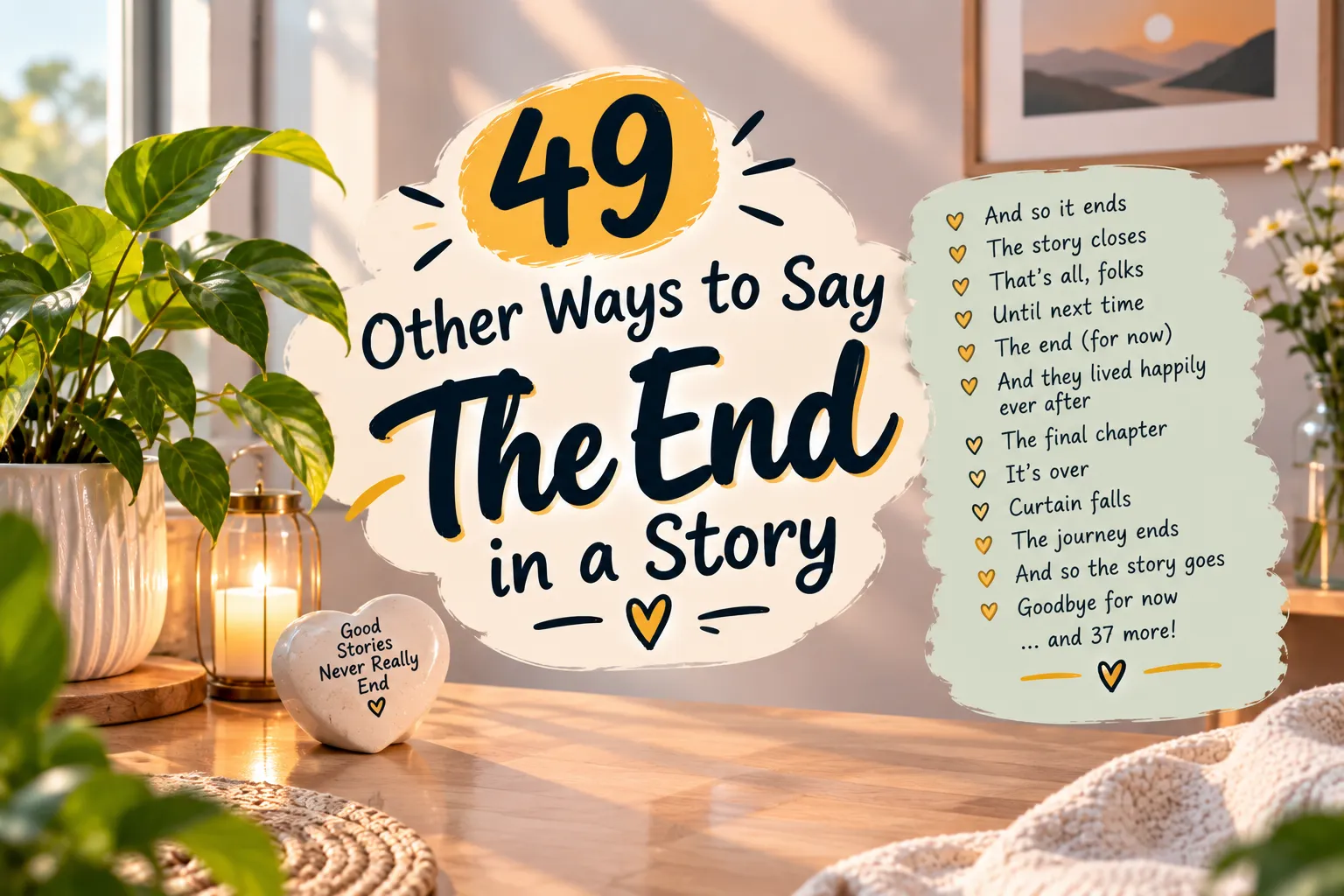
In this guide, you’ll discover 49 other ways to say “the end” in a story, along with meanings, usage tips, and examples to help you choose the right expression.
When Should You Use These Alternatives?
You can use different alternatives to “the end” depending on the tone and purpose of your story.
- For a simple ending: Use phrases such as “And that was it” or “The story ends here.”
- For an emotional ending: Try “And so their journey came to an end” or “They said their final goodbyes.”
- For a dramatic ending: Use “The final chapter had arrived” or “And then, everything changed.”
- For a happy ending: Choose “They lived happily ever after” or “And so they found their happily ever after.”
- For an open ending: Use “But their story was not over” or “What happened next was left untold.”
- For a literary ending: Expressions such as “And the rest became history” can create a more polished feel.
The best ending is not necessarily the most dramatic one. Choose a phrase that matches the story’s mood and gives the reader a satisfying final feeling.
49 Other Ways to Say “The End” in a Story
1. And so the story ends
Meaning: This is a straightforward and slightly literary way to signal that the story has reached its conclusion. It works particularly well when you want a calm, traditional ending.
Usage: Use it at the very end of a narrative or fictional story. It sounds more polished than simply writing “The End.”
Tip: This phrase works especially well in storytelling and narration.
- And so the story ends, with everyone finally at peace.
- After years of searching, and so the story ends.
- And so the story ends where it all began.
- With one final smile, and so the story ends.
2. And that was the end
Meaning: This phrase clearly tells the reader that the events are finished. It has a conversational and natural tone.
Usage: It is useful in personal stories, children’s stories, and informal narratives. It can also create a slightly nostalgic feeling.
Tip: Use it when you want a simple, uncomplicated ending.
- They closed the door behind them, and that was the end.
- Nobody ever spoke about the incident again, and that was the end.
- He returned home safely, and that was the end of the adventure.
- They finally made peace, and that was the end.
3. The story ends here
Meaning: This directly tells the reader that the narrative has reached its stopping point. It is clear and easy to understand.
Usage: This phrase is suitable for simple stories, essays, and informal writing.
Tip: It can also work when intentionally creating a firm stopping point.
- After everything they had experienced, the story ends here.
- There is nothing more to tell; the story ends here.
- With one final goodbye, the story ends here.
- For now, the story ends here.
4. And so it ends
Meaning: This is a short, dramatic alternative to “The End.” It suggests that an important journey or sequence has finally finished.
Usage: It works especially well in dramatic, historical, or emotional writing.
Tip: Its short structure gives it a strong final impact.
- After years of conflict, and so it ends.
- The final battle was over, and so it ends.
- Their long journey was finally complete, and so it ends.
- The waiting was finally over. And so it ends.
5. The end of the journey
Meaning: This phrase describes the conclusion of a character’s physical or emotional journey.
Usage: It is especially effective when your story focuses on growth, challenges, or transformation.
Tip: Use “journey” metaphorically when the character has changed throughout the story.
- At last, they reached the end of the journey.
- He smiled as he realized he had reached the end of the journey.
- The end of the journey brought peace.
- She had finally arrived at the end of her journey.
6. The final chapter
Meaning: “The final chapter” refers to the last part of a story or the final stage of someone’s experience.
Usage: It works both literally and metaphorically.
Tip: This phrase is particularly useful when your story is divided into chapters.
- This was the final chapter of their adventure.
- The final chapter brought everything together.
- At last, they reached the final chapter.
- Nobody knew what the final chapter would bring.
7. Their journey came to an end
Meaning: This phrase shows that a character’s experience or adventure has finished.
Usage: It is suitable for emotional, adventurous, and inspirational stories.
Tip: It sounds natural when the story follows characters through several challenges.
- After many years, their journey came to an end.
- Together, they watched as their journey came to an end.
- Their journey came to an end beneath the summer sky.
- At last, their journey came to an end.
8. And the rest is history
Meaning: This phrase means that the events that followed became part of a memorable past.
Usage: Use it when the ending connects to something famous, memorable, or significant.
Tip: It can make a story ending feel confident and memorable.
- They opened the little shop together, and the rest is history.
- One conversation changed everything, and the rest is history.
- They met by chance, and the rest is history.
- From that day forward, the rest is history.
9. They lived happily ever after
Meaning: This classic expression indicates a happy ending, especially in fairy tales.
Usage: Use it for romantic stories, children’s stories, fairy tales, and playful writing.
Tip: It is familiar and works best when the story genuinely has a happy ending.
- They married the following spring and lived happily ever after.
- After overcoming every obstacle, they lived happily ever after.
- The prince and princess returned home and lived happily ever after.
- Finally reunited, they lived happily ever after.
10. And they lived happily ever after
Meaning: This is a longer version of the classic fairy-tale ending.
Usage: It works naturally in traditional children’s stories and romantic tales.
Tip: Use it when you want a warm, familiar conclusion.
- They found each other again, and they lived happily ever after.
- The kingdom was finally peaceful, and they lived happily ever after.
- Their troubles were over, and they lived happily ever after.
- They chose love, and they lived happily ever after.
11. The story comes to a close
Meaning: This phrase means that the story is finishing.
Usage: It has a polished and slightly literary tone.
Tip: It works well in formal storytelling and narrative writing.
- As the sun disappeared, the story came to a close.
- With one final conversation, the story comes to a close.
- Their adventure slowly came to a close.
- And now, the story comes to a close.
12. The curtain falls
Meaning: This metaphor compares the ending of a story to the closing curtain after a theatrical performance.
Usage: It is excellent for dramatic, artistic, or theatrical writing.
Tip: Use it when you want the ending to feel symbolic.
- The curtain falls on their remarkable journey.
- After one final scene, the curtain falls.
- The battle is over, and the curtain falls.
- With her final words, the curtain falls.
13. The final scene
Meaning: “The final scene” refers to the last moment or sequence of a story.
Usage: It is particularly suitable for novels, films, plays, and dramatic narratives.
Tip: Use it when describing a memorable visual ending.
- The final scene showed them standing together.
- In the final scene, everything became clear.
- The final scene was quiet but powerful.
- As the final scene unfolded, she understood the truth.
14. The last page
Meaning: This phrase refers to the literal or symbolic end of a story.
Usage: It is especially effective in books and literary writing.
Tip: “The last page” can also suggest that the characters’ lives continue beyond the story.
- He closed the book after reading the last page.
- The last page revealed the truth.
- On the last page, they finally reunited.
- She smiled as she turned the last page.
15. The final words
Meaning: This phrase highlights the last words spoken or written in the story.
Usage: It works well when the final sentence has special emotional significance.
Tip: Use it when the ending revolves around dialogue or narration.
- Those were his final words.
- Her final words stayed with him forever.
- The final words brought tears to everyone’s eyes.
- Nobody expected those to be her final words.
16. The adventure ends here
Meaning: This phrase tells the reader that an adventure has officially finished.
Usage: It works especially well for travel stories, fantasy, children’s fiction, and action narratives.
Tip: It creates a clear but friendly ending.
- After crossing the mountains, the adventure ends here.
- They laughed as they realized the adventure ends here.
- The adventure ends here, but the memories remain.
- For now, the adventure ends here.
17. Their story was complete
Meaning: This suggests that the characters’ story has reached a satisfying conclusion.
Usage: It is useful for emotional and character-driven narratives.
Tip: It can sound more elegant than simply saying “the story is over.”
- After years apart, their story was complete.
- Everything had fallen into place, and their story was complete.
- With one final embrace, their story was complete.
- At last, their story was complete.
18. The tale comes to an end
Meaning: This is a traditional and literary way to say that a story has finished.
Usage: It works particularly well in fairy tales, fantasy stories, and classic-style narratives.
Tip: “Tale” gives the phrase a more storybook feeling.
- And so the tale comes to an end.
- After many twists and turns, the tale comes to an end.
- With peace restored, the tale comes to an end.
- The tale comes to an end beneath the stars.
19. And that is where our story ends
Meaning: This phrase clearly identifies the final point of the narrative.
Usage: It works well in first-person or conversational storytelling.
Tip: “Our story” creates a sense of connection between the narrator and reader.
- We went our separate ways, and that is where our story ends.
- They never met again, and that is where our story ends.
- With one final goodbye, that is where our story ends.
- And that is where our story ends.
20. Their chapter closed
Meaning: This metaphor suggests that an important period of someone’s life has finished.
Usage: It is common in emotional, reflective, and literary writing.
Tip: “Chapter” is especially effective when the story focuses on personal change.
- After ten years together, their chapter closed.
- With her departure, their chapter closed.
- Their chapter closed quietly.
- That difficult chapter finally closed.
21. A new chapter begins
Meaning: This phrase signals the end of one part of a story while suggesting the beginning of another.
Usage: It is ideal for hopeful or open-ended stories.
Tip: Use it when you want the ending to feel like a beginning rather than a complete stop.
- The old life was over, and a new chapter begins.
- As they left the town, a new chapter began.
- Their past was behind them; a new chapter begins.
- With courage in her heart, a new chapter began.
22. Their story had reached its conclusion
Meaning: This is a polished way of saying that the story has fully finished.
Usage: It works well in literary, academic, and formal narrative writing.
Tip: Use it when you want a more sophisticated tone.
- After years of conflict, their story had reached its conclusion.
- Everything was finally resolved, and their story had reached its conclusion.
- Their story had reached its conclusion at last.
- By sunset, their story had reached its conclusion.
23. The final chapter had arrived
Meaning: This suggests that the characters have entered the final stage of their story.
Usage: It is useful for dramatic or suspenseful narratives.
Tip: It creates anticipation before the final resolution.
- After years of struggle, the final chapter had arrived.
- Everyone knew the final chapter had arrived.
- The final chapter had arrived, and there was no turning back.
- At last, the final chapter had arrived.
24. The journey was over
Meaning: This simple phrase indicates that an adventure, experience, or period of life has finished.
Usage: It works in almost any narrative involving a journey.
Tip: Its simplicity makes it powerful after a long description.
- After months of traveling, the journey was over.
- They looked back and realized the journey was over.
- The journey was over, but the memories remained.
- At sunrise, the journey was over.
25. The story was finished
Meaning: This is a direct and uncomplicated way to say that the narrative has ended.
Usage: It works best in simple or informal storytelling.
Tip: Use it when clarity is more important than literary style.
- He put down his pen. The story was finished.
- Once the final sentence was written, the story was finished.
- Their story was finished.
- The story was finally finished.
26. The tale was told
Meaning: This phrase suggests that the story has been completely shared.
Usage: It has a traditional, almost folklore-like quality.
Tip: It works particularly well in historical or fantasy storytelling.
- The tale was told, and the village fell silent.
- Once the tale was told, everyone went home.
- The tale was told for generations.
- At last, the tale was told.
27. Their final goodbye
Meaning: This phrase suggests that the story ends with a permanent farewell.
Usage: It is best for emotional or bittersweet stories.
Tip: Use it when separation is an important part of the ending.
- They shared their final goodbye at the station.
- That morning marked their final goodbye.
- With tears in her eyes, she gave him her final goodbye.
- Their final goodbye said more than words could.
28. And with that, it was over
Meaning: This expression indicates that something ended immediately after a particular event.
Usage: It is natural in conversational and dramatic storytelling.
Tip: It works especially well after a powerful final action.
- He walked away, and with that, it was over.
- The door closed, and with that, it was over.
- She told the truth, and with that, it was over.
- The final bell rang, and with that, it was over.
29. And so the journey ends
Meaning: This is a poetic way to announce the conclusion of an adventure or life experience.
Usage: It works well in reflective, emotional, and inspirational stories.
Tip: It is especially effective after a long character journey.
- After everything they had faced, and so the journey ends.
- The mountains were behind them, and so the journey ends.
- With peace finally restored, the journey ends.
- And so the journey ends, but the memories remain.
30. The final moment arrives
Meaning: This phrase indicates that the decisive or concluding moment has come.
Usage: It works well in suspenseful or dramatic stories.
Tip: Use it when the ending centers around one important event.
- At last, the final moment arrives.
- The final moment arrives as the clock strikes midnight.
- Nobody knew what would happen when the final moment arrived.
- Then, suddenly, the final moment arrived.
31. The story is complete
Meaning: This means all major events have been resolved and nothing essential remains to be told.
Usage: It works well for polished or literary storytelling.
Tip: It can sound more satisfying than simply saying “finished.”
- Every question had been answered, and the story was complete.
- With the final piece in place, the story was complete.
- Their story was finally complete.
- The story was complete, but its meaning remained.
32. The final page is turned
Meaning: This metaphor describes reaching the end of a story as though physically turning the final page of a book.
Usage: It works beautifully in literary and reflective writing.
Tip: It can create a strong visual image for the reader.
- The final page was turned, and silence followed.
- With the final page turned, their story was over.
- She smiled as the final page was turned.
- Once the final page is turned, there is no going back.
33. And the story fades away
Meaning: This poetic phrase suggests that the story gradually disappears into the past.
Usage: It works well for nostalgic, emotional, or bittersweet endings.
Tip: Choose it when you want a softer ending rather than a definite stop.
- The lights dimmed, and the story faded away.
- As the years passed, the story faded away.
- Their voices disappeared, and the story faded away.
- Slowly, the story faded away.
34. The tale is over
Meaning: This is a simple and direct way to say that the story has finished.
Usage: It works well in informal, traditional, and children’s storytelling.
Tip: It is short enough to create a clean ending.
- The battle was finished. The tale is over.
- Their adventure ended, and the tale is over.
- With one final sentence, the tale is over.
- The tale is over, but its lesson remains.
35. Their story comes to a close
Meaning: This phrase indicates that the characters’ story is reaching its final point.
Usage: It is appropriate for emotional and literary narratives.
Tip: It sounds natural when followed by a meaningful final image.
- As the sun set, their story came to a close.
- Their story comes to a close beside the old house.
- After everything they endured, their story came to a close.
- And finally, their story comes to a close.
36. The final chapter closes
Meaning: This phrase metaphorically describes the end of a major part of someone’s story.
Usage: It works especially well for reflective and emotional writing.
Tip: It creates a sense of finality without sounding too blunt.
- The final chapter closes with a quiet goodbye.
- At last, the final chapter closes.
- The final chapter closes, but the memories remain.
- Their final chapter closes beneath the evening sky.
37. And so the tale ends
Meaning: This is a traditional and slightly poetic alternative to “The End.”
Usage: It works well in fairy tales, fantasy stories, and classic narratives.
Tip: It has a timeless storybook quality.
- And so the tale ends with peace restored.
- After many adventures, and so the tale ends.
- And so the tale ends beneath a silver moon.
- With everyone reunited, and so the tale ends.
38. The final curtain
Meaning: “The final curtain” is a metaphor for the ending of a performance or story.
Usage: It works especially well for dramatic and theatrical writing.
Tip: It creates a strong sense of finality.
- The final curtain fell on their adventure.
- As the final curtain descended, the audience remained silent.
- The final curtain marked the end of an era.
- At last, the final curtain fell.
39. The last goodbye
Meaning: This phrase emphasizes a final farewell between characters.
Usage: It is best for emotional, romantic, or bittersweet endings.
Tip: Use it when the goodbye itself is the emotional climax.
- They shared one last goodbye before parting.
- Nobody knew it would be their last goodbye.
- Their last goodbye was quiet and sincere.
- She remembered his last goodbye for years.
40. Everything came full circle
Meaning: This means the ending connects back to the beginning of the story.
Usage: It is ideal when an ending mirrors an earlier event, location, phrase, or idea.
Tip: This phrase is especially effective in stories with strong themes or symbolism.
- In the final scene, everything came full circle.
- They returned to the place where they first met, and everything came full circle.
- Her final decision showed that everything had come full circle.
- The ending made everything come full circle.
41. The circle was complete
Meaning: This phrase suggests that the story’s events have reached a satisfying conclusion.
Usage: It works well in symbolic and reflective stories.
Tip: Use it when the ending connects meaningfully to the beginning.
- They returned home, and the circle was complete.
- With that final decision, the circle was complete.
- Years later, the circle was finally complete.
- The circle was complete at last.
42. The story reaches its final note
Meaning: This poetic phrase compares the end of a story to the final note of a piece of music.
Usage: It works well in literary, artistic, and emotional writing.
Tip: Use it for a gentle, elegant ending.
- The story reaches its final note beneath the stars.
- With her final words, the story reaches its final note.
- The story slowly reaches its final note.
- And now, the story reaches its final note.
43. The final chapter is written
Meaning: This phrase suggests that the events of the story have been completed.
Usage: It works well for reflective, historical, and dramatic narratives.
Tip: It can also imply that the characters have accepted their fate.
- At last, the final chapter is written.
- After years of struggle, the final chapter was written.
- Their final chapter is written in memory.
- With that decision, the final chapter was written.
44. Their story becomes a memory
Meaning: This phrase suggests that the events are now part of the past.
Usage: It works beautifully for nostalgic or bittersweet endings.
Tip: Choose it when you want to emphasize remembrance rather than finality.
- Their story became a memory that never faded.
- With time, their story became a memory.
- The adventure ended, and their story became a memory.
- Years later, their story remained a cherished memory.
45. The journey reaches its final destination
Meaning: This phrase compares the conclusion of a story to reaching the end of a physical journey.
Usage: It works well for adventure stories and narratives about personal growth.
Tip: It gives the ending a strong sense of completion.
- After years of searching, the journey reached its final destination.
- Their journey had finally reached its final destination.
- At sunset, the journey reached its final destination.
- The journey reached its final destination, but a new one awaited.
46. And life went on
Meaning: This phrase suggests that the particular story ended, but life continued afterward.
Usage: It is excellent for realistic, reflective, or bittersweet endings.
Tip: Use it when you want to remind readers that endings can also be beginnings.
- They said goodbye, and life went on.
- The town slowly recovered, and life went on.
- The story ended, but life went on.
- They remembered the past and then moved forward. Life went on.
47. Their story continued beyond the page
Meaning: This phrase suggests that the characters’ lives continue even though the written story has ended.
Usage: It is especially useful for open-ended or hopeful conclusions.
Tip: It works well when you do not want the ending to feel completely final.
- The book ended, but their story continued beyond the page.
- Although we said goodbye, their story continued beyond the page.
- Their story continued beyond the page, full of new possibilities.
- The final sentence arrived, but their story continued beyond the page.
48. What came next was left untold
Meaning: This phrase deliberately leaves the future unknown to the reader.
Usage: It is ideal for mysterious, open-ended, or imaginative stories.
Tip: Use it when you want readers to imagine what happened afterward.
- What came next was left untold.
- They walked into the distance, and what came next was left untold.
- The door closed behind her, and what came next was left untold.
- Their future remained a mystery, and what came next was left untold.
49. And that is where the story ends
Meaning: This is a clear, natural, and slightly reflective way to bring a narrative to a close.
Usage: It works in almost any type of story, especially when the narrator is directly addressing the reader.
Tip: It is a strong choice when you want your final sentence to feel intentional and complete.
- They finally found their way home, and that is where the story ends.
- He smiled one last time, and that is where the story ends.
- The two friends went their separate ways, and that is where the story ends.
- The sun rose over the quiet town, and that is where the story ends.
Bonus: Creative Ways to End a Story Without Saying “The End”
If you want your story ending to feel less predictable, you do not always need a phrase that literally announces the ending. Sometimes the strongest conclusion simply shows the reader that the story is finished.
End with a memorable image
Leave the reader with a visual moment.
Example:
The last light disappeared behind the mountains, and she finally smiled.
End with dialogue
A character’s final words can create a powerful emotional finish.
Example:
“I think we’re finally home,” he whispered.
End with a reflection
Let the narrator look back on everything that happened.
Example:
Years later, she still remembered that summer as the moment everything changed.
End with a new beginning
Show that one story has ended while another is about to begin.
Example:
She closed the old diary, opened the new one, and began to write.
End with an unanswered question
This can create mystery and encourage readers to imagine what happens next.
Example:
But where had the mysterious letter really come from?
How to Choose the Right Ending Phrase
The best alternative to “The End” depends on the feeling you want to leave with your reader.
For a happy ending
Try:
- They lived happily ever after.
- And so they found their happiness.
- A new beginning awaited them.
- Their story had a happy ending.
For a sad ending
Try:
- Their final goodbye.
- Their journey came to an end.
- Their story became a memory.
- And life went on.
For a dramatic ending
Try:
- And so it ends.
- The final chapter had arrived.
- The curtain falls.
- The final moment arrives.
For an open ending
Try:
- Their story continued beyond the page.
- What came next was left untold.
- A new chapter begins.
- The rest remains a mystery.
For a literary ending
Try:
- And so the tale ends.
- The story comes to a close.
- Everything came full circle.
- The story reaches its final note.
Final Tips for Ending a Story Naturally
- Match the phrase to the mood: A romantic story may need a warmer ending than a mystery.
- Avoid unnecessary repetition: You do not have to explicitly say “the end” if your final scene already makes it obvious.
- Think about the reader’s final emotion: Decide whether you want them to feel happy, sad, curious, peaceful, or surprised.
- Use the final sentence carefully: The last line often stays with the reader longer than any other sentence.
- Consider an open ending: Not every story needs to explain exactly what happens next.
- Connect the ending to the beginning: A full-circle ending can make a story feel especially satisfying.
- Keep it natural: The best ending usually feels like a natural result of everything that came before it.
A story can end with a single sentence, a powerful image, a final goodbye, or even a quiet moment. Instead of relying on “The End,” choose an ending that reflects your characters, your message, and the emotional journey you have taken the reader through.