
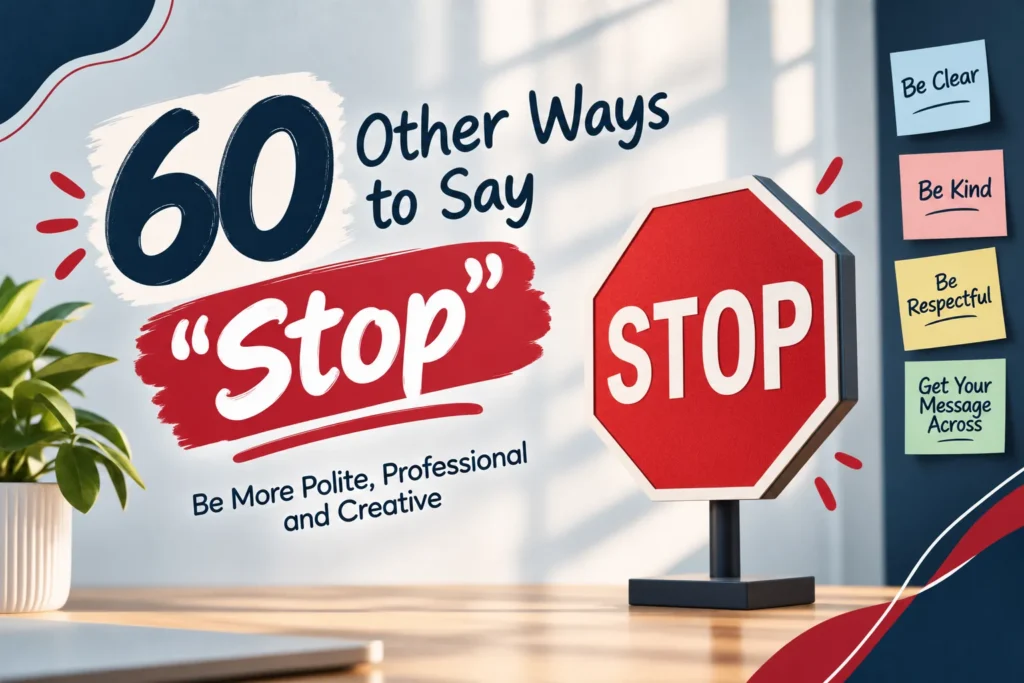
Sometimes, “stop” is exactly the right word. It is short, clear, and easy to understand. However, depending on the situation, it can also sound too direct, especially when you are speaking to someone at work, talking to a stranger, correcting a child, or trying to express yourself politely.
Knowing different ways to say “stop” gives you more control over your tone. You might want to ask someone to pause, tell them to discontinue an action, warn them to stop immediately, or simply ask for a moment of silence. Each situation calls for slightly different language.
In this guide, you’ll find 60 other ways to say “stop”, ranging from polite and professional expressions to casual phrases, firm warnings, and natural everyday alternatives. Examples are included so you can understand not only what each phrase means, but also when it sounds appropriate.
What Does “Stop” Mean?
The word “stop” generally means to end an action, activity, movement, or process. It can also mean to prevent something from continuing or to tell another person that you want an action to end.
For example, “Stop talking” directly tells someone to end the action of talking. In a more polite situation, you might say, “Could you please be quiet for a moment?” The basic intention is similar, but the tone is very different.
The best alternative depends on who you are speaking to, what is happening, and how strongly you need to communicate your message.
When Should You Use These Alternatives?
Different alternatives to “stop” work better in different situations:
- With friends: Casual expressions such as “Cut it out” or “Knock it off” can sound natural when you know the person well.
- At work: “Please discontinue,” “Let’s pause here,” or “Could we put this on hold?” can sound more professional.
- In an urgent situation: “Stop right there,” “Hold on,” or “Don’t move” can communicate urgency quickly.
- When making a polite request: “Could you please stop?” or “Would you mind stopping?” softens the instruction.
- When ending an activity: “Let’s call it a day” or “Let’s wrap things up” can sound more natural than simply saying “stop.”
- When someone is doing something annoying: “Please cut that out” or “Enough, please” can communicate your frustration without unnecessarily escalating the situation.
A useful rule is to consider tone before vocabulary. The same idea can sound friendly, neutral, professional, or aggressive depending on the expression you choose.
1. Please Stop
Meaning/Definition: This is one of the simplest polite alternatives to “stop.” Adding “please” makes the request softer while keeping the meaning clear.
Usage: Use it when you want someone to end an action without sounding unnecessarily harsh. It works in everyday conversations, although your tone of voice still matters.
💡 Tip: “Please stop” is polite enough for many situations but can still sound firm when necessary.
Examples:
- Please stop talking while I’m explaining this.
- Please stop tapping your pen on the desk.
- Please stop sending messages while you’re driving.
- Please stop arguing and listen for a moment.
2. Could You Please Stop?
Meaning/Definition: This turns the instruction into a polite question. It asks someone to discontinue what they are doing without giving a blunt command.
Usage: It is useful when speaking to coworkers, acquaintances, friends, or people you do not know very well. It sounds less forceful than simply saying “Stop.”
💡 Tip: Use this when you want to be clear without sounding confrontational.
Examples:
- Could you please stop interrupting me?
- Could you please stop making that noise?
- Could you please stop moving the documents?
- Could you please stop for a moment?
3. Would You Mind Stopping?
Meaning/Definition: This is a polite way to ask someone to discontinue an action. It is especially useful when you want your request to sound considerate.
Usage: It works well in professional and social situations where a direct command might feel too strong. Remember that “Would you mind…” is normally followed by the -ing form.
💡 Tip: “Would you mind stopping?” sounds more courteous than “Stop.”
Examples:
- Would you mind stopping for a second?
- Would you mind stopping the music?
- Would you mind stopping that conversation for a moment?
- Would you mind stopping the machine?
4. Could You Hold On?
Meaning/Definition: “Hold on” can mean to pause or stop temporarily. It often suggests that you want someone to wait rather than end something permanently.
Usage: Use it when you need someone to pause during a conversation or activity. It is common in everyday spoken English.
💡 Tip: “Hold on” usually means pause for a moment, not necessarily “never do it again.”
Examples:
- Could you hold on while I check the information?
- Hold on, I need to explain something.
- Could you hold on before you make that decision?
- Hold on a second—I think we missed a step.
5. Hang On a Second
Meaning/Definition: This casual phrase asks someone to pause briefly. It is similar to “hold on.”
Usage: It is common among friends, coworkers, and family members. Avoid it in highly formal writing unless the context is conversational.
💡 Tip: “Hang on” usually suggests a short pause rather than a complete end.
Examples:
- Hang on a second; I’m almost finished.
- Hang on, I need to answer this call.
- Hang on before you leave.
- Hang on a second and let me explain.
6. Give It a Rest
Meaning/Definition: “Give it a rest” means to stop doing or talking about something, especially when it has become annoying or repetitive. It can sound slightly irritated.
Usage: It is mainly used in informal conversations. Use it carefully because it can sound dismissive.
💡 Tip: This expression is better suited to people you know than formal situations.
Examples:
- Give it a rest—you’ve made the same joke five times.
- Can you give it a rest for a while?
- Give the argument a rest and let’s move on.
- He finally told them to give it a rest.
7. Cut It Out
Meaning/Definition: “Cut it out” is a common informal way to tell someone to stop doing something annoying or inappropriate. It is stronger than a simple polite request.
Usage: It is often used with friends, siblings, children, or people you know well. It can sound rude if used with a stranger or in a formal setting.
💡 Tip: Use “cut it out” when the situation is informal and you want to sound firm.
Examples:
- Cut it out! You’re distracting everyone.
- Can you two cut it out?
- Cut it out with the teasing.
- She told her brother to cut it out.
8. Knock It Off
Meaning/Definition: “Knock it off” means stop doing something annoying, troublesome, or inappropriate. It is informal and fairly direct.
Usage: You might hear it between friends, family members, or adults correcting someone’s behavior. It is not generally appropriate for formal professional communication.
💡 Tip: Because it can sound commanding, use it only when a firm tone is acceptable.
Examples:
- Knock it off and leave your sister alone.
- Guys, knock it off.
- He told the children to knock it off.
- Knock it off with the constant interruptions.
9. Enough
Meaning/Definition: “Enough” tells someone that something has gone too far and needs to end. It is extremely short and can communicate strong emotion.
Usage: Use it when you need to make your message clear immediately. Depending on your tone, it can sound either serious or angry.
💡 Tip: In tense situations, your tone can make “Enough” much stronger than the word itself.
Examples:
- Enough. We are not arguing about this anymore.
- That’s enough for today.
- Enough with the excuses.
- She finally said, “Enough.”
Looking for more ways to refuse or decline naturally? Explore other ways to say “No” — 41 natural and professional alternatives for every situation.
10. That’s Enough
Meaning/Definition: This expression tells someone that they have done or said enough and should stop. It is often used to set a clear boundary.
Usage: It works in family, classroom, workplace, and everyday situations. It can be firm without necessarily being aggressive.
💡 Tip: “That’s enough” is useful when you want to end something decisively.
Examples:
- That’s enough. Please take your seat.
- That’s enough discussion for today.
- That’s enough noise while the baby is sleeping.
- I think that’s enough for now.
11. Stop It
Meaning/Definition: “Stop it” directly tells someone to end what they are doing. It is one of the most common everyday expressions.
Usage: It can be playful, annoyed, serious, or affectionate depending on context and tone. It is especially common in spoken English.
💡 Tip: The tone determines whether “stop it” sounds friendly or angry.
Examples:
- Stop it—you’re making me laugh.
- Stop it and listen to me.
- Stop it, that really hurts.
- Oh, stop it! You’re embarrassing me.
12. Stop That
Meaning/Definition: “Stop that” specifically refers to an action someone is currently doing. It is direct and easy to understand.
Usage: It is useful when you want to identify an unwanted behavior without explaining it in detail. It is common in everyday speech.
💡 Tip: Use “stop that” when the unwanted action is obvious from the context.
Examples:
- Stop that right now.
- Stop that—you’re going to break it.
- Please stop that tapping.
- Stop that and come over here.
13. Stop What You’re Doing
Meaning/Definition: This phrase tells someone to immediately discontinue their current activity. It is stronger and more specific than simply saying “stop.”
Usage: It is appropriate when the action itself needs to end immediately, especially in situations involving safety or urgency.
💡 Tip: Use it when you need someone’s full attention.
Examples:
- Stop what you’re doing and step away from the door.
- Please stop what you’re doing for a moment.
- Stop what you’re doing and look at this.
- The teacher told the students to stop what they were doing.
14. Stop Right There
Meaning/Definition: “Stop right there” tells someone to stop moving or continuing immediately. It often communicates urgency or authority.
Usage: It is commonly used when someone is physically moving away or about to do something you want to prevent. It can sound very firm.
💡 Tip: Reserve this phrase for situations where an immediate stop is genuinely needed.
Examples:
- Stop right there!
- Stop right there and listen to me.
- The guard shouted, “Stop right there!”
- Stop right there—you forgot your phone.
15. Don’t Continue
Meaning/Definition: “Don’t continue” means do not carry on with an action or process. It is clear but somewhat formal.
Usage: It can work in instructions, professional communication, or situations where you want to prevent something from progressing.
💡 Tip: In casual conversation, “Don’t keep going” usually sounds more natural.
Examples:
- Don’t continue until you receive approval.
- Please don’t continue with the installation.
- Don’t continue if you feel uncomfortable.
- The notice instructed workers not to continue.
16. Don’t Go Any Further
Meaning/Definition: This expression tells someone not to proceed beyond a certain point. It can refer to physical movement or an idea, plan, or argument.
Usage: Use it when someone is about to cross a boundary or proceed further. It can be literal or figurative.
💡 Tip: This phrase is particularly useful when setting boundaries.
Examples:
- Don’t go any further without checking the map.
- Please don’t go any further with the project yet.
- Don’t go any further—the road is closed.
- I’m asking you not to go any further with this discussion.
17. Put an End to It
Meaning/Definition: “Put an end to it” means deliberately bring something to a conclusion. It is stronger and more formal than simply saying “stop.”
Usage: It can describe ending an argument, habit, problem, activity, or situation. It works in both speech and writing.
💡 Tip: Use this phrase when you want to emphasize a definite ending.
Examples:
- We need to put an end to these unnecessary arguments.
- She decided to put an end to the rumor.
- The manager put an end to the discussion.
- It’s time to put an end to this problem.
18. Bring It to an End
Meaning/Definition: This phrase means to cause something to finish. It is more formal and deliberate than “stop.”
Usage: It works well in professional, academic, and formal contexts. It is useful when discussing meetings, projects, conflicts, or processes.
💡 Tip: Choose this phrase when you want your language to sound measured and professional.
Examples:
- Let’s bring the meeting to an end.
- We need to bring this disagreement to an end.
- The organization decided to bring the program to an end.
- It was time to bring the conversation to an end.
19. Discontinue
Meaning/Definition: “Discontinue” means to stop doing, providing, producing, or using something. It is a formal and precise alternative to “stop.”
Usage: It is especially common in business, healthcare, product information, and official communication. It usually refers to something being ended rather than a person being told to stop immediately.
💡 Tip: Use “discontinue” when discussing a service, product, process, or ongoing activity.
Examples:
- The company will discontinue the product next year.
- Please discontinue use if irritation occurs.
- The service was discontinued last month.
- We have decided to discontinue the old procedure.
20. Cease
Meaning/Definition: “Cease” means to stop completely. It is formal and often appears in official, legal, academic, or serious contexts.
Usage: It is rarely the most natural choice in casual conversation. However, it is useful when you need a formal expression for ending an action.
💡 Tip: “Cease” sounds considerably more formal than “stop.”
Examples:
- The company was ordered to cease operations.
- Please cease all communication with the client.
- The noise finally ceased after midnight.
- The organization called for the violence to cease.
21. Desist
Meaning/Definition: “Desist” means to stop doing something, particularly an action that is unwanted or inappropriate. It is a formal word.
Usage: It is most common in formal notices, legal contexts, and serious warnings. It would sound unusual in ordinary conversation.
💡 Tip: Use “desist” when a formal or authoritative tone is appropriate.
Examples:
- You are requested to desist from further contact.
- The notice ordered the company to desist.
- He was warned to desist from making threats.
- The letter asked them to desist from using the material.
22. Refrain From
Meaning/Definition: “Refrain from” means deliberately avoid doing something. It is a polite and formal way of asking someone not to perform an action.
Usage: It is common in workplace policies, notices, instructions, and formal communication. It is normally followed by a noun or an -ing verb.
💡 Tip: “Please refrain from…” is a useful professional alternative to “Please stop…”
Examples:
- Please refrain from using your phone during the meeting.
- Visitors are asked to refrain from touching the exhibits.
- Please refrain from making unnecessary noise.
- Employees should refrain from sharing confidential information.
23. Quit
Meaning/Definition: “Quit” can mean to stop doing something, especially an activity, habit, or behavior. It is common in informal spoken English.
Usage: You can say “Quit talking,” “Quit complaining,” or “Quit bothering me.” It can sound blunt, so context matters.
💡 Tip: “Quit” often sounds stronger than “stop” in casual speech.
Examples:
- Quit complaining and help me finish this.
- Please quit making that noise.
- He told his brother to quit teasing him.
- Quit worrying about things you cannot control.
24. Quit It
Meaning/Definition: “Quit it” means stop doing something irritating or unwanted. It is informal and direct.
Usage: It is mainly used in spoken English with friends, siblings, children, or people you know well.
💡 Tip: Avoid “quit it” in formal workplace communication.
Examples:
- Quit it! You’re distracting me.
- Can you quit it with the jokes?
- Quit it and give me some space.
- She told him to quit it.
25. Leave It Alone
Meaning/Definition: “Leave it alone” means stop touching, discussing, changing, or interfering with something. It can also mean stop bothering a person.
Usage: It is useful when someone is interfering with something that should not be disturbed. The phrase can be literal or figurative.
💡 Tip: Use it when the main issue is unwanted interference.
Examples:
- Leave my phone alone.
- Just leave the issue alone for now.
- Leave that button alone.
- Please leave her alone and give her some time.
26. Let It Go
Meaning/Definition: “Let it go” means stop focusing on, arguing about, or worrying about something. It often suggests emotional release rather than physically stopping an action.
Usage: Use it when encouraging someone to move past an argument, mistake, disappointment, or minor problem.
💡 Tip: “Let it go” is usually about releasing an issue rather than stopping an immediate action.
Examples:
- It was a small disagreement, so let it go.
- You apologized already; let it go.
- Let it go and focus on what you can change.
- She decided to let the argument go.
27. Drop It
Meaning/Definition: “Drop it” means stop talking about or pursuing a particular subject. It can sound quite firm.
Usage: It is common in arguments or situations where someone does not want to discuss something further.
💡 Tip: Because “drop it” can sound irritated, use a softer alternative in professional situations.
Examples:
- I don’t want to discuss it, so drop it.
- Please drop it and move on.
- He asked them to drop the subject.
- Let’s drop it for now.
Need more emphatic ways to express disbelief or refusal? Check out other ways to say “No Way” — 33 natural and expressive alternatives for every situation.
28. Leave It
Meaning/Definition: “Leave it” can mean stop touching or interfering with something. It can also mean abandon an issue or task.
Usage: It is common in British English and everyday conversations. Context determines exactly what the speaker wants stopped.
💡 Tip: Add context when necessary because “leave it” can have several meanings.
Examples:
- Leave it—I’ll take care of it.
- Leave it alone and step back.
- Just leave it for now.
- Leave it; we can discuss it tomorrow.
29. Back Off
Meaning/Definition: “Back off” means stop interfering, pressuring, criticizing, or moving closer. It can be quite confrontational.
Usage: Use it when someone is crossing a personal or conversational boundary. It is informal and often firm.
💡 Tip: Avoid “back off” in polite professional communication unless the situation genuinely requires a strong boundary.
Examples:
- Back off and give me some space.
- You need to back off a little.
- He told the reporters to back off.
- Please back off and let her handle it.
30. Give Me a Break
Meaning/Definition: “Give me a break” can mean stop bothering, criticizing, or pressuring me. It can also express disbelief, so context is important.
Usage: It is informal and often emotional. Friends and family commonly use it during frustrating conversations.
💡 Tip: It does not always literally mean “stop,” so consider the context before using it.
Examples:
- Give me a break—I’ve been working all morning.
- Give me a break with those excuses.
- Can you give me a break for five minutes?
- Oh, give me a break! That can’t be serious.
31. Take a Break
Meaning/Definition: “Take a break” means pause an activity rather than necessarily ending it permanently. It is often used when someone needs rest.
Usage: It works well at work, school, during exercise, or when someone has been concentrating for a long time.
💡 Tip: Use this when the goal is a temporary pause rather than a permanent stop.
Examples:
- You’ve been studying for three hours. Take a break.
- Let’s take a break and continue after lunch.
- Take a break if you’re feeling tired.
- We decided to take a short break.
32. Pause for a Moment
Meaning/Definition: This phrase asks someone to temporarily stop an action. It sounds polite and controlled.
Usage: It is especially useful in meetings, presentations, conversations, and professional situations.
💡 Tip: “Pause for a moment” sounds less confrontational than “stop.”
Examples:
- Could you pause for a moment?
- Let’s pause for a moment and review the numbers.
- Please pause for a moment before answering.
- She asked everyone to pause for a moment.
33. Let’s Pause Here
Meaning/Definition: “Let’s pause here” means stop temporarily at the current point. It suggests that the activity may continue later.
Usage: This is especially natural in meetings, lessons, discussions, and collaborative work.
💡 Tip: It is a useful professional alternative when you do not want to sound commanding.
Examples:
- Let’s pause here and come back to this tomorrow.
- I think we should pause here.
- Let’s pause here before making a final decision.
- We paused here to review the results.
34. Put It on Hold
Meaning/Definition: “Put it on hold” means temporarily stop or delay something. It does not necessarily mean the activity is permanently canceled.
Usage: It is common in business, projects, customer service, and everyday planning.
💡 Tip: Use this when something is being delayed rather than permanently ended.
Examples:
- Let’s put the project on hold for now.
- We had to put the renovation on hold.
- The company put the launch on hold.
- Can we put this discussion on hold until tomorrow?
35. Hold Off
Meaning/Definition: “Hold off” means delay doing something or wait before taking action. It is different from permanently stopping something.
Usage: It is common in workplace conversations and everyday English when a person wants someone to wait.
💡 Tip: “Hold off” is best when you mean wait, not end completely.
Examples:
- Hold off on sending the email.
- Let’s hold off until we have more information.
- Can you hold off for a few minutes?
- They decided to hold off on the purchase.
36. Call It Off
Meaning/Definition: “Call it off” means cancel something that was planned or already arranged. It does not normally mean stopping an action that is happening at this exact moment.
Usage: It is commonly used for meetings, events, plans, trips, or agreements.
💡 Tip: Use “call it off” for cancellation rather than ordinary stopping.
Examples:
- They called off the meeting.
- We had to call off the trip because of the weather.
- The organizers called off the event.
- Should we call it off for tonight?
37. Wrap It Up
Meaning/Definition: “Wrap it up” means finish something soon. It is often used when someone wants an activity, meeting, conversation, or task to end.
Usage: It is common in workplaces, classrooms, and casual conversations. It is usually less abrupt than simply saying “stop.”
💡 Tip: Use it when you want people to finish what they are doing rather than stop suddenly.
Examples:
- We have five minutes left, so let’s wrap it up.
- Can you wrap it up before lunch?
- The manager asked everyone to wrap it up.
- Let’s wrap things up and head home.
38. Call It a Day
Meaning/Definition: “Call it a day” means stop working or finish an activity for the day. It usually suggests that the work can continue another time.
Usage: It is especially common in workplace and casual conversations.
💡 Tip: This phrase is ideal when you are ending a work session rather than stopping something permanently.
Examples:
- We’ve done enough for today. Let’s call it a day.
- It’s getting late, so I’m going to call it a day.
- The team decided to call it a day.
- Let’s call it a day and continue tomorrow.
39. Put a Pause on It
Meaning/Definition: This means temporarily stop or suspend an activity, plan, or process. It is useful when the intention is to revisit something later.
Usage: It works well in professional and everyday contexts.
💡 Tip: “Put a pause on it” is softer than saying something is canceled.
Examples:
- We decided to put a pause on the campaign.
- Let’s put a pause on this discussion.
- The team put a pause on the project.
- I think we should put a pause on our plans.
40. Suspend It
Meaning/Definition: “Suspend” means temporarily stop an activity, service, process, or privilege. It often implies that the activity could resume later.
Usage: It is more formal than “put it on hold” and is common in official and professional contexts.
💡 Tip: Use “suspend” when describing an organized or formal interruption.
Examples:
- The service was temporarily suspended.
- The school suspended the activity.
- We may need to suspend operations.
- The company suspended the program during the review.
41. Discontinue the Activity
Meaning/Definition: This formal expression means to stop an activity completely. It clearly communicates that the activity should no longer continue.
Usage: It is appropriate for professional instructions, policies, reports, and formal communication.
💡 Tip: This sounds more official than simply saying “stop the activity.”
Examples:
- Please discontinue the activity immediately.
- The school decided to discontinue the activity.
- Participants were asked to discontinue the activity.
- The organization discontinued the activity after the review.
42. Stop Carrying On
Meaning/Definition: “Stop carrying on” can mean stop behaving noisily, foolishly, dramatically, or excessively. It is more common in British English.
Usage: It is generally informal and often used when someone is making a fuss or behaving in an exaggerated way.
💡 Tip: Use it carefully because it can sound dismissive.
Examples:
- Stop carrying on and tell me what happened.
- They were told to stop carrying on.
- You need to stop carrying on about the mistake.
- Stop carrying on like that.
43. Stop Making a Fuss
Meaning/Definition: This expression tells someone to stop complaining, worrying, or making a situation seem more serious than it is.
Usage: It is informal and is more common in British English. It can sound patronizing depending on the relationship.
💡 Tip: Avoid it when someone is genuinely upset or dealing with a serious problem.
Examples:
- Stop making a fuss; it’s only a small scratch.
- She told him to stop making a fuss.
- There’s no need to make a fuss about it.
- He kept making a fuss over the minor problem.
44. Settle Down
Meaning/Definition: “Settle down” can mean become quieter, calmer, or less excited. It is not always a direct synonym for “stop.”
Usage: It is commonly used with children, groups, or people who are being noisy or overly excited.
💡 Tip: Use it when the problem is mainly noise, excitement, or restless behavior.
Examples:
- Everyone, settle down so we can begin.
- The children eventually settled down.
- Please settle down and listen.
- The classroom became quiet after the students settled down.
Not sure what to say in an uncertain situation? Read our guide on other ways to say “I Don’t Know” — 21 natural and professional alternatives for every conversation.
45. Be Quiet
Meaning/Definition: “Be quiet” specifically asks someone to stop making noise or talking. It does not mean stopping every kind of activity.
Usage: It is simple and common, but it can sound blunt without “please.”
💡 Tip: Say “Could you please be quiet?” when you want a softer tone.
Examples:
- Please be quiet during the presentation.
- Could you be quiet for a minute?
- Everyone became quiet when the teacher entered.
- I need you to be quiet while I make this call.
46. Keep It Down
Meaning/Definition: “Keep it down” means reduce the amount of noise you are making. It is not a request to become completely silent.
Usage: It is common in homes, workplaces, dormitories, and other shared spaces.
💡 Tip: Use this when someone is being too loud rather than when you want total silence.
Examples:
- Could you keep it down? I’m studying.
- Please keep it down after midnight.
- The neighbors asked us to keep it down.
- Keep it down while the baby is sleeping.
47. Tone It Down
Meaning/Definition: “Tone it down” means make something less intense, loud, emotional, extreme, or aggressive. It does not necessarily mean stop completely.
Usage: It can describe speech, behavior, music, criticism, or emotional reactions.
💡 Tip: Use it when you want someone to reduce intensity rather than completely stop.
Examples:
- Could you tone it down a little?
- You need to tone down the criticism.
- The music needs to be toned down.
- He was asked to tone down his response.
48. Take It Easy
Meaning/Definition: “Take it easy” can mean slow down, relax, or stop putting too much pressure on yourself. It is not a direct synonym for “stop.”
Usage: It is useful when someone is working too hard, moving too quickly, or becoming overly stressed.
💡 Tip: Use it as friendly advice rather than a firm command.
Examples:
- Take it easy—you’ve been working all day.
- You should take it easy for a while.
- Take it easy and don’t rush.
- She told him to take it easy after a long day.
49. Slow Down
Meaning/Definition: “Slow down” means reduce speed or intensity rather than stop completely. It can apply to physical movement, speech, work, or decision-making.
Usage: It is common in everyday conversations and can be used as both advice and a command.
💡 Tip: Choose “slow down” when stopping completely is unnecessary.
Examples:
- Slow down; you’re walking too fast.
- Could you slow down when you explain this?
- Slow down before you make a decision.
- The driver slowed down near the school.
50. Ease Up
Meaning/Definition: “Ease up” means become less intense, strict, forceful, or demanding. It usually suggests reducing pressure rather than stopping completely.
Usage: It is informal and works well when talking about pressure, criticism, exercise, or demanding behavior.
💡 Tip: “Ease up” is useful when someone needs to reduce intensity.
Examples:
- You need to ease up on the criticism.
- Ease up a little; everyone is doing their best.
- The coach told the players to ease up.
- Could you ease up on the pressure?
51. Leave It for Now
Meaning/Definition: This phrase means stop dealing with something temporarily and return to it later. It is a gentle way to suggest a pause.
Usage: It works well when a discussion, task, or problem is becoming unproductive.
💡 Tip: Use it when you want to postpone something rather than abandon it.
Examples:
- Let’s leave it for now and come back tomorrow.
- Leave that question for now.
- We should leave the decision for now.
- I’m too tired to solve this, so I’ll leave it for now.
52. Move On
Meaning/Definition: “Move on” means stop focusing on something and continue with another subject, task, or stage. It often applies to conversations and emotional situations.
Usage: It is useful when something has already been discussed enough or when continued attention is no longer productive.
💡 Tip: “Move on” focuses on what comes next rather than simply telling someone to stop.
Examples:
- We’ve discussed the issue, so let’s move on.
- It’s time to move on to the next topic.
- Try to move on from the mistake.
- Once everyone agreed, we moved on.
53. Let’s Leave It There
Meaning/Definition: This phrase means stop discussing or dealing with something at the current point. It often suggests that no further discussion is needed.
Usage: It is particularly natural in meetings, disagreements, and professional conversations.
💡 Tip: It is a tactful way to end a discussion without saying “stop talking.”
Examples:
- I think we’ve covered enough, so let’s leave it there.
- We disagree, and that’s okay. Let’s leave it there.
- Let’s leave it there and revisit the matter later.
- I think we should leave it there for today.
54. Let’s Not Go There
Meaning/Definition: “Let’s not go there” means avoid discussing or pursuing a particular subject. It often suggests that the topic could lead to an argument or uncomfortable situation.
Usage: It is informal and common in everyday conversations.
💡 Tip: Use it when you want to prevent a conversation from moving into unwanted territory.
Examples:
- Let’s not go there—we’ve already argued about it.
- I’d rather not discuss that. Let’s not go there.
- We can talk about the project, but let’s not go there.
- He knew better than to bring it up, so they didn’t go there.
55. Forget It
Meaning/Definition: “Forget it” can mean stop discussing, pursuing, or worrying about something. Depending on tone, it can also sound frustrated or dismissive.
Usage: It is common in casual conversations but should be used carefully because it can sound abrupt.
💡 Tip: Use “Never mind” instead when you want a softer tone.
Examples:
- Forget it; it’s not worth arguing about.
- Forget it, I’ll handle it myself.
- If you’re not interested, forget it.
- Forget it—we can talk about this later.
56. Never Mind
Meaning/Definition: “Never mind” means do not worry about something or stop pursuing the current issue. It is often softer than “forget it.”
Usage: It is common in everyday English when someone wants to withdraw a question, dismiss a minor problem, or move on.
💡 Tip: “Never mind” is generally friendlier than “forget it.”
Examples:
- Never mind; I figured it out.
- Never mind what I said earlier.
- If it’s too complicated, never mind.
- Never mind—let’s talk about something else.
57. Enough Already
Meaning/Definition: “Enough already” strongly communicates that you are tired of something continuing. It usually carries frustration or impatience.
Usage: It is informal and should be used when a firm emotional tone is appropriate.
💡 Tip: Avoid it in professional settings unless you intentionally need a very strong tone.
Examples:
- Enough already! We’ve heard the story.
- Enough already with the complaints.
- She finally shouted, “Enough already!”
- Can we have some peace and quiet? Enough already.
58. Give It a Break
Meaning/Definition: “Give it a break” can mean stop doing, discussing, or complaining about something for a while. It is informal and similar to “give it a rest.”
Usage: It is common in casual English, particularly when someone is being repetitive or annoying.
💡 Tip: Use it with people you know because it can sound dismissive.
Examples:
- Give it a break—you’ve been complaining all morning.
- Can you give it a break with the jokes?
- Give the argument a break for a while.
- He told them to give it a break.
59. Stop Right Now
Meaning/Definition: “Stop right now” is a strong and immediate instruction. It clearly tells someone that the action must end at once.
Usage: Use it when immediate action is important, such as during a dangerous, inappropriate, or disruptive situation.
💡 Tip: Because it is forceful, use it when urgency justifies a strong command.
Examples:
- Stop right now and step away from the equipment.
- You need to stop right now.
- Stop right now before someone gets hurt.
- The teacher told the students to stop right now.
60. Don’t Do That Again
Meaning/Definition: “Don’t do that again” tells someone to stop a behavior and not repeat it in the future. It focuses more on future behavior than the immediate action.
Usage: It is useful when someone has already done something inappropriate, annoying, or unsafe and you want to establish a clear boundary.
💡 Tip: Use this when the important message is that the behavior must not happen again.
Examples:
- Please don’t do that again.
- Don’t do that again—it could have been dangerous.
- I understand your apology, but don’t do that again.
- She calmly told him not to do that again.
Polite Ways to Say “Stop”
When you need to sound respectful, especially with coworkers, teachers, customers, acquaintances, or strangers, avoid unnecessarily harsh expressions.
Some useful choices include:
- Could you please stop?
- Would you mind stopping?
- Could you pause for a moment?
- Let’s pause here.
- Please refrain from doing that.
- Could you keep it down, please?
- Let’s leave it there for now.
- Could we put this on hold?
The key is that politeness does not mean being unclear. You can make a firm request while still choosing language that respects the other person.
Professional Alternatives to “Stop”
In professional English, the best alternative depends on what you want to stop.
For an activity, “discontinue” or “suspend” may be appropriate. For a discussion, “let’s pause here” or “let’s leave it there” can sound more collaborative. If you want someone to avoid a particular behavior, “please refrain from…” is a common formal structure.
For example, instead of writing:
Stop sending these files.
A professional version could be:
Please refrain from sending additional files until the review is complete.
The second sentence communicates the same basic instruction while giving the reader more context and a more professional tone.
Casual Ways to Say “Stop”
When talking to friends or family, everyday expressions can sound much more natural than formal vocabulary.
Depending on the situation, you could say:
- Cut it out.
- Knock it off.
- Quit it.
- Give it a rest.
- Give it a break.
- Drop it.
- Back off.
- Enough already.
However, these expressions are not interchangeable. “Cut it out” usually means stop an annoying behavior, while “drop it” usually means stop discussing a particular subject. “Back off” is more about giving someone space or reducing pressure.
How to Choose the Right Alternative to “Stop”
Choosing the right phrase is less about finding a perfect synonym and more about matching the meaning and tone to the situation.
For a polite request: Use “Could you please stop?” or “Would you mind stopping?”
For an urgent situation: Use “Stop right there,” “Stop right now,” or “Stop what you’re doing.”
For a temporary pause: Choose “Hold on,” “Pause for a moment,” or “Put it on hold.”
For ending a discussion: Try “Drop it,” “Let’s leave it there,” or “Let’s move on.”
For formal communication: Use “Discontinue,” “Suspend,” “Cease,” or “Please refrain from…”
For casual conversations: “Cut it out,” “Knock it off,” and “Quit it” can sound natural.
For reducing intensity: Choose “Slow down,” “Tone it down,” or “Ease up” rather than “stop” if you do not actually want the person to quit completely.
Common Mistake: Not Every “Stop” Means the Same Thing
One important point for English learners is that “stop,” “pause,” “quit,” “cancel,” and “hold off” are not always interchangeable.
If you say, “Stop the project,” you may suggest that the project should end. If you say, “Put the project on hold,” you usually mean the project is temporarily delayed.
Similarly, “Stop talking” means end the talking, while “Pause for a moment” normally means take a short break and continue afterward.
Understanding these small differences can make your English sound much more natural and precise.
Frequently Asked Questions
What is a polite way to say “stop”?
“Could you please stop?” is one of the simplest polite alternatives. “Would you mind stopping?” and “Could you pause for a moment?” can sound even softer depending on the situation.
What is a professional way to say “stop”?
In professional English, you can use phrases such as “Please refrain from…,” “Please discontinue…,” “Let’s pause here,” or “We need to put this on hold.” The best option depends on whether you mean stop permanently or temporarily.
What is a nicer way to say “stop”?
Try “Could you please stop?”, “Would you mind stopping?”, or “Let’s pause for a moment.” These expressions communicate the request without sounding unnecessarily aggressive.
What is another word for “stop” in formal English?
Depending on the context, formal alternatives include cease, discontinue, suspend, desist, and refrain from. They have different meanings, so they should not be treated as exact replacements in every sentence.
What is a casual way to say “stop”?
Common casual expressions include “cut it out,” “knock it off,” “quit it,” “give it a rest,” and “give it a break.” These can sound natural with friends and family but may be too informal for professional situations.
What can I say instead of “stop talking”?
You can say “Please be quiet,” “Could you keep it down?”, “Could we pause the conversation?”, “Let’s leave it there,” or “Let’s move on,” depending on what you actually want the person to do.
Final Takeaway
There is no single replacement for “stop” that works in every situation. The most natural choice depends on whether you want someone to pause, finish, cancel, reduce an action, stop immediately, or simply move on.
For polite situations, phrases such as “Could you please stop?” and “Would you mind stopping?” are useful. For professional communication, “please refrain from,” “discontinue,” and “suspend” can work well. In casual conversations, expressions such as “cut it out,” “knock it off,” and “give it a rest” may sound more natural.
Learning these differences helps you do more than avoid repeating the word “stop.” It helps you choose English that matches the situation, relationship, urgency, and tone, which is what makes everyday communication sound more natural and confident.