
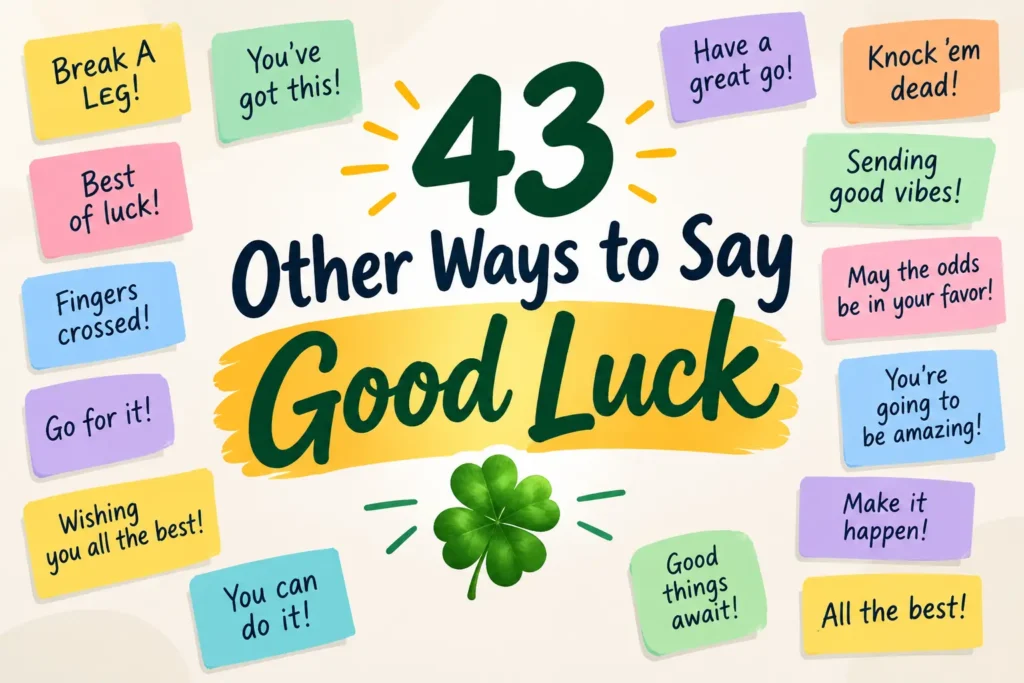
Sometimes, a simple “good luck” is enough—but sometimes you want your words to feel more personal, encouraging, or appropriate for the situation. Whether someone is taking an exam, starting a new job, giving a presentation, competing in an event, or facing an important decision, choosing the right expression can make your message more meaningful.
Learning 43 other ways to say good luck can also help you sound more natural and confident in English. These alternatives give students, professionals, ESL learners, and everyday English speakers more ways to express encouragement without repeating the same phrase. In 2026, having a flexible vocabulary is especially useful when communicating through emails, chats, social media, workplace messages, and face-to-face conversations.
When Should You Use These Alternatives?
The best alternative depends on your relationship with the person, the situation, and the tone you want to create.
- Casual conversations: Use friendly expressions such as “You’ve got this!” or “Go for it!” when encouraging friends, classmates, or people you know well.
- Professional situations: Choose polished expressions such as “I wish you every success” when speaking with colleagues, clients, managers, or professional contacts.
- Academic writing: In formal academic contexts, direct encouragement is usually better than slang or playful expressions. “I wish you success with your research” is more suitable than “Knock ’em dead!”
- Emails and messages: Short phrases such as “Best of luck!” or “Wishing you all the best” work well when you want your message to sound warm without being overly familiar.
- Social media posts: Creative expressions such as “Go smash it!” or “Here’s to a great outcome!” can make posts and comments feel more energetic.
- Public speaking: Encouraging phrases such as “I’m rooting for you” or “Wishing you a successful presentation” can sound supportive before an important event.
⚠️ Warning: Not every alternative works in every situation. Expressions such as “Break a leg” are idiomatic and informal, while phrases such as “I wish you every success” are more appropriate for professional or formal settings. Always consider your audience before choosing an expression.
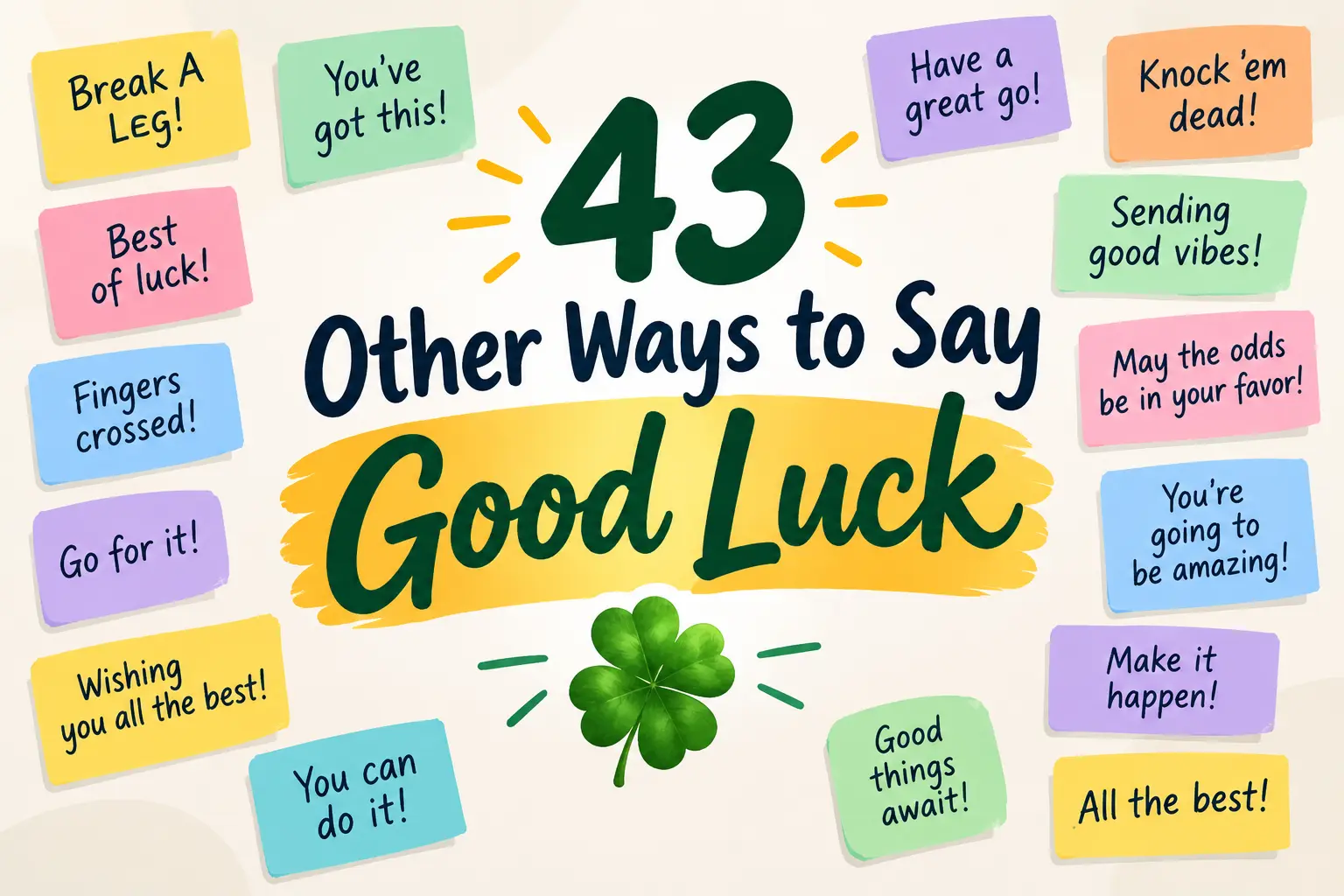
43 Other Ways to Say “Good Luck”
1. Best of luck
Meaning / Definition
“Best of luck” is a warm way to wish someone a successful outcome. It has almost the same meaning as “good luck” but can sound slightly more personal.
Usage
This phrase is semi-formal and works in both spoken and written English. You can use it with friends, classmates, coworkers, or acquaintances before an important event.
💡 Tip
Use “Best of luck” when you want a safe, natural alternative that works in many situations.
Examples
- Best of luck with your driving test tomorrow!
- Best of luck with your new position at the company.
- Best of luck to everyone competing in the tournament.
- I heard about your interview—best of luck!
2. All the best
Meaning / Definition
“All the best” expresses warm wishes for someone’s future success or happiness. It is broader than “good luck” because it can apply to an entire new chapter rather than one specific event.
Usage
It is semi-formal and very common in emails, messages, and everyday conversations. You can use it before an exam, move, job change, trip, or other important occasion.
💡 Tip
Use it when you want to wish someone well without focusing only on success.
Examples
- All the best with your upcoming exams.
- All the best as you begin your new job.
- You’re moving abroad next month? All the best!
- All the best for whatever comes next.
3. Wishing you the best
Meaning / Definition
“Wishing you the best” communicates sincere hopes that things go well for another person. It sounds warm and thoughtful without being overly formal.
Usage
This is a semi-formal expression suitable for messages, cards, emails, and conversations. It works especially well when someone is entering an important or uncertain situation.
💡 Tip
Use this phrase when you want your encouragement to feel genuine rather than routine.
Examples
- Wishing you the best in your new role.
- Wishing you the best as you prepare for your final exam.
- I know this opportunity means a lot to you, so I’m wishing you the best.
- Wishing you the best with your next adventure.
4. Wishing you every success
Meaning / Definition
“Wishing you every success” expresses a strong hope that someone achieves their goals. It emphasizes successful results more directly than “all the best.”
Usage
This phrase is formal or semi-formal and is particularly useful in professional communication. It fits farewell messages, business emails, applications, and major career milestones.
💡 Tip
Choose this expression when “good luck” feels too casual for the situation.
Examples
- Wishing you every success in your new position.
- We wish you every success with your business venture.
- Wishing you every success in your future career.
- Please accept my best wishes, and I wish you every success.
5. You’ve got this!
Meaning / Definition
“You’ve got this!” means that you believe someone is capable of handling a difficult situation. It offers confidence and encouragement rather than simply wishing for luck.
Usage
This is casual and energetic, making it ideal for friends, classmates, teammates, and people you know well. It is especially natural before exams, interviews, competitions, and presentations.
💡 Tip
Use an exclamation mark in texts when you want the encouragement to feel enthusiastic.
Examples
- Your interview starts in ten minutes—you’ve got this!
- Don’t worry about the presentation; you’ve got this!
- You’ve studied all week, so you’ve got this!
- Go into the final with confidence. You’ve got this!
6. Go for it!
Meaning / Definition
“Go for it!” encourages someone to take action and pursue an opportunity. It suggests confidence and enthusiasm rather than simply hoping things turn out well.
Usage
This is casual and works best in conversations with friends, classmates, teammates, or family members. It is useful when someone is deciding whether to try something challenging.
💡 Tip
Use “Go for it!” when the person needs motivation to act.
Examples
- You’ve always wanted to audition, so go for it!
- If you think the job is right for you, go for it!
- You’re ready for the competition—go for it!
- Send your proposal today and go for it!
7. I’m rooting for you
Meaning / Definition
“I’m rooting for you” means that you strongly support someone and hope they succeed. It communicates personal encouragement and emotional support.
Usage
This is casual to semi-formal and is common in conversations and friendly messages. It works particularly well when someone is facing a challenge or competing against others.
💡 Tip
Use it when you want to emphasize your support, not just the outcome.
Examples
- Your interview is tomorrow, and I’m rooting for you.
- I know how hard you’ve worked for this race—I’m rooting for you!
- Whatever happens, know that I’m rooting for you.
- Everyone in our team is rooting for you tonight.
8. Knock ’em dead
Meaning / Definition
“Knock ’em dead” is an idiomatic way to encourage someone to perform extremely well. It does not literally mean to hurt anyone; it means “impress everyone.”
Usage
This expression is casual and often used before performances, presentations, auditions, or public appearances. Avoid it in highly formal professional or academic writing.
💡 Tip
Use it with people who understand informal English and appreciate playful encouragement.
Examples
- You’re going on stage now—knock ’em dead!
- Good luck with your audition tonight. Knock ’em dead!
- Your presentation is going to be fantastic, so knock ’em dead.
- Have fun at the conference and knock ’em dead with your speech!
9. Break a leg
Meaning / Definition
“Break a leg” is a traditional idiom used to wish performers good luck. Although the words sound negative, the expression is normally meant positively.
Usage
It is informal and is especially associated with theater, performances, auditions, and similar events. It may sound unusual if used in a formal business email or with someone unfamiliar with the expression.
💡 Tip
Use it mainly when someone is about to perform or appear on stage.
Examples
- Your play starts tonight—break a leg!
- Break a leg at your audition this afternoon.
- Everyone wished the actors good luck before saying, “Break a leg!”
- You’ve rehearsed for months, so break a leg tonight!
10. Fingers crossed
Meaning / Definition
“Fingers crossed” expresses hope that something will have a positive result. It is often used when the outcome is uncertain.
Usage
This is casual and common in spoken English, texts, and social media. It works well when someone is waiting for exam results, job news, acceptance, or another outcome.
💡 Tip
It can stand alone or follow a statement about something you hope will happen.
Examples
- Fingers crossed that you get the scholarship!
- Your interview went well, so fingers crossed.
- Fingers crossed for good news from the university.
- We’ve submitted the application—now fingers crossed!
11. Best wishes
Meaning / Definition
“Best wishes” expresses kind and positive hopes for another person. It is a flexible expression that can communicate encouragement without sounding overly casual.
Usage
It is semi-formal and frequently appears in cards, emails, letters, and messages. You can use it for exams, new jobs, moves, projects, and other milestones.
💡 Tip
“Best wishes” is a reliable choice when you are unsure how formal your message should be.
Examples
- Best wishes for your upcoming examination.
- Best wishes as you start your new position.
- Sending my best wishes for your presentation tomorrow.
- Best wishes on this exciting new chapter.
12. I wish you success
Meaning / Definition
“I wish you success” directly expresses a hope that someone achieves their objective. It is clear, positive, and easy for English learners to understand.
Usage
This phrase is formal or semi-formal and works particularly well in professional and academic settings. It can be used in speeches, letters, emails, and serious conversations.
💡 Tip
Use it when you want your message to sound respectful and straightforward.
Examples
- I wish you success in your new career.
- We wish you success with your research project.
- I sincerely wish you success in the competition.
- I wish you success as you launch your new business.
13. May everything go well
Meaning / Definition
“May everything go well” expresses a sincere hope that a situation develops positively. It focuses on the overall experience rather than one specific achievement.
Usage
This is semi-formal and can be used in thoughtful messages or conversations. It is useful when the person is facing a major event with several possible outcomes.
💡 Tip
Use it when you want to sound caring and optimistic.
Examples
- May everything go well with your move tomorrow.
- You’ve prepared carefully, so may everything go well.
- May everything go well during your first week at work.
- We’re thinking of you and hoping everything goes well.
14. Hope it goes well
Meaning / Definition
“Hope it goes well” is a simple way to express hope for a positive outcome. It is less formal and more conversational than “I wish you success.”
Usage
This is casual and works naturally in texts, chats, and everyday conversations. It can be used before almost any event where someone wants a good result.
💡 Tip
It is particularly natural when replying to someone who has just told you about an upcoming event.
Examples
- I heard you have an interview tomorrow. Hope it goes well!
- Good luck with your appointment—I hope it goes well.
- Hope it goes well with your presentation today.
- You’re meeting the new clients this afternoon? Hope it goes well.
15. Have a great one
Meaning / Definition
“Have a great one” is a friendly expression wishing someone a positive experience. Depending on context, “one” can refer to a day, event, trip, meeting, or experience.
Usage
This is casual and works best in spoken English and informal messages. It is more general than “good luck,” so it fits situations where you want someone to enjoy the event as well as succeed.
💡 Tip
Use it when the specific event does not need to be mentioned.
Examples
- Enjoy the concert tonight—have a great one!
- You’re heading to the tournament? Have a great one!
- Have a great one at the conference tomorrow.
- Good luck with your trip, and have a great one!
16. Give it your best shot
Meaning / Definition
“Give it your best shot” encourages someone to make their strongest possible effort. It does not guarantee success but emphasizes trying wholeheartedly.
Usage
This is casual and encouraging, especially among friends, students, and teammates. It works well before tests, competitions, applications, and challenging tasks.
💡 Tip
Use it when effort matters as much as the final result.
Examples
- You’ve prepared well, so give the interview your best shot.
- Even if the problem looks difficult, give it your best shot.
- Go into the final round and give it your best shot.
- You may not know every answer, but give it your best shot.
17. Give it your all
Meaning / Definition
“Give it your all” means to put all your effort, energy, and determination into something. It is a strong form of encouragement.
Usage
This is casual to semi-formal and is common in sports, education, work, and personal situations. It is especially appropriate when someone has an important challenge ahead.
💡 Tip
Use this phrase when you want to encourage maximum effort.
Examples
- The championship is tomorrow, so give it your all.
- Give it your all during the final presentation.
- You’ve come this far—give it your all today.
- Whatever happens, give it your all and be proud of your effort.
18. Go smash it!
Meaning / Definition
“Go smash it!” is an energetic expression meaning “Go and do extremely well.” It communicates enthusiasm, confidence, and strong encouragement.
Usage
This is very informal and is most natural among friends, teammates, and people with a relaxed relationship. It is common in conversational British English and informal online communication.
💡 Tip
Avoid it in formal letters or professional situations where a polished tone is expected.
Examples
- Your first day is tomorrow—go smash it!
- You’ve trained for months, so go smash it at the competition.
- Go smash that presentation today!
- The whole team believes in you. Go smash it!
19. You’ll do great
Meaning / Definition
“You’ll do great” expresses confidence that someone will perform well. It reassures the person and focuses on their ability rather than chance.
Usage
This is casual and natural in conversations and messages. It is especially useful when someone feels nervous before an exam, interview, speech, or performance.
💡 Tip
Use it when you know the person has prepared and needs reassurance.
Examples
- Don’t be nervous about the interview—you’ll do great.
- You’ve practiced your speech so many times. You’ll do great!
- I know this is your first competition, but you’ll do great.
- Relax and trust yourself; you’ll do great tomorrow.
20. You’re going to do amazing
Meaning / Definition
“You’re going to do amazing” is an enthusiastic way to express confidence in someone’s performance. It tells the person that you strongly expect them to succeed or impress others.
Usage
This is casual and emotionally supportive. It works well in texts and conversations with friends, family members, classmates, or coworkers you know well.
💡 Tip
Use it when you want your encouragement to sound especially enthusiastic.
Examples
- Your audition is finally here—you’re going to do amazing!
- I’ve seen how much you’ve practiced, and you’re going to do amazing.
- That presentation is going to be amazing because you know the subject so well.
- Trust yourself—you’re going to do amazing at the event.
21. I’m wishing you the best
Meaning / Definition
“I’m wishing you the best” expresses personal support and positive hopes for someone’s situation. It sounds warmer than a short “good luck.”
Usage
This is semi-formal and works in conversations, messages, emails, and cards. It is particularly suitable when someone is facing a meaningful change or challenge.
💡 Tip
This is a good choice when you want to sound sincere without being overly dramatic.
Examples
- I know the interview is important, so I’m wishing you the best.
- I’m wishing you the best as you begin university.
- You’ve worked hard on this project, and I’m wishing you the best.
- I’m wishing you the best in whatever comes next.
22. Sending positive vibes
Meaning / Definition
“Sending positive vibes” communicates encouragement and optimistic thoughts. It has a relaxed, upbeat tone.
Usage
This is informal and particularly common in texts, social media, and friendly conversations. It is suitable for situations where someone is waiting for news or facing a stressful event.
💡 Tip
Use it with friends rather than in formal professional correspondence.
Examples
- Sending positive vibes for your exam tomorrow!
- You’ve got an important interview today—sending positive vibes your way.
- Sending positive vibes and hoping everything works out.
- Big presentation today? Sending positive vibes!
23. Here’s to your success
Meaning / Definition
“Here’s to your success” is a positive expression that celebrates or anticipates someone’s achievement. It conveys optimism and support.
Usage
This is semi-formal and can work in speeches, messages, celebrations, and professional settings. It is especially natural when someone is beginning a new project or career opportunity.
💡 Tip
Use it when you want to make the message feel celebratory.
Examples
- Here’s to your success in your new business!
- You’ve worked hard to reach this point—here’s to your success.
- Here’s to your success as you begin your new role.
- Let’s raise a glass to the project and here’s to your success.
24. May you succeed
Meaning / Definition
“May you succeed” is a direct expression of hope for someone’s achievement. It has a sincere and somewhat formal tone.
Usage
This is formal or literary and is less common in casual conversation. It can work in speeches, written messages, ceremonial situations, or thoughtful wishes.
💡 Tip
Use it when you want your wording to sound respectful and deliberate.
Examples
- May you succeed in all your future endeavors.
- May you succeed in reaching the goals you have set.
- May you succeed in your studies and future career.
- We hope that you succeed in this important undertaking.
25. I hope you nail it
Meaning / Definition
“I hope you nail it” means “I hope you perform extremely well.” The word “nail” is informal slang meaning to do something successfully.
Usage
This is casual and is common in conversations and texts. It is especially suitable for exams, interviews, presentations, performances, and competitions.
💡 Tip
Use it with people who are comfortable with informal English.
Examples
- I hope you nail the interview tomorrow!
- You know the material, so I hope you nail the exam.
- I hope you nail your presentation this afternoon.
- You’ve rehearsed everything—now go in there and nail it!
26. Go get ’em!
Meaning / Definition
“Go get ’em!” is an energetic expression encouraging someone to pursue a challenge confidently. It suggests determination and action.
Usage
This is casual and often used before competitions, interviews, performances, or difficult tasks. It is best suited to friendly conversations rather than formal writing.
💡 Tip
Use it when you want to energize someone immediately before an important moment.
Examples
- Your big interview is today—go get ’em!
- The final match starts soon. Go get ’em, team!
- You’ve prepared for this moment, so go get ’em!
- Walk into that meeting confidently and go get ’em!
27. Best wishes for your success
Meaning / Definition
“Best wishes for your success” combines a warm personal wish with a direct reference to achievement. It makes the intended encouragement very clear.
Usage
This is formal or semi-formal and works well in professional messages, letters, academic communication, and congratulatory notes. It is more polished than casual expressions such as “You’ve got this.”
💡 Tip
Choose it when you want to sound respectful and supportive at the same time.
Examples
- Best wishes for your success in your new position.
- Please accept my best wishes for your success in the competition.
- Best wishes for your success with this important project.
- We send our best wishes for your success in your future career.
28. I hope you succeed
Meaning / Definition
“I hope you succeed” directly communicates that you want another person to achieve their goal. It is simple and easy to understand.
Usage
This is neutral to semi-formal and works in many everyday situations. Depending on tone, it can sound supportive, sincere, or slightly serious.
💡 Tip
Add a personal reason when appropriate to make it warmer.
Examples
- I hope you succeed in getting the scholarship.
- I really hope you succeed with your new project.
- We hope you succeed in reaching your fundraising goal.
- I hope you succeed in everything you’re working toward.
29. I hope everything works out
Meaning / Definition
“I hope everything works out” expresses hope that a complicated or uncertain situation ends positively. It focuses on the overall outcome rather than a specific achievement.
Usage
This is casual to semi-formal and is common in conversations and messages. It is especially useful when someone is dealing with several unknown factors.
💡 Tip
Use this phrase when “good luck” feels too simple for a complicated situation.
Examples
- I know the move has been stressful, but I hope everything works out.
- You’ve submitted your application—now I hope everything works out.
- I hope everything works out with your new business.
- Whatever happens tomorrow, I hope everything works out for you.
30. May fortune be on your side
Meaning / Definition
“May fortune be on your side” is a creative way of wishing someone favorable circumstances. It has a slightly dramatic or literary feel.
Usage
This is semi-formal to playful and is not usually used in ordinary business communication. It can work well in creative writing, friendly messages, games, or humorous situations.
💡 Tip
Use it when you deliberately want a more imaginative alternative to “good luck.”
Examples
- The competition begins tonight—may fortune be on your side!
- You’re entering the tournament tomorrow, so may fortune be on your side.
- As you begin this adventure, may fortune be on your side.
- May fortune be on your side when the results are announced.
31. Good fortune to you
Meaning / Definition
“Good fortune to you” expresses a wish that someone experiences favorable circumstances or success. It sounds more traditional than everyday “good luck.”
Usage
This is formal, literary, or playful depending on context. It is more suitable for creative messages, speeches, or humorous situations than ordinary workplace chats.
💡 Tip
Use it sparingly because it can sound old-fashioned in everyday English.
Examples
- Good fortune to you as you begin your journey.
- We wish you good fortune in your new venture.
- Good fortune to you in the competition ahead.
- As you take on this challenge, good fortune to you.
32. May the odds be in your favor
Meaning / Definition
“May the odds be in your favor” means “I hope circumstances work in your favor.” It is a humorous or dramatic way to wish someone success.
Usage
This is informal and is often used jokingly when a situation involves competition, uncertainty, or difficult chances. It is best used when the audience understands the expression’s cultural reference.
💡 Tip
Use it for a playful tone rather than a serious professional message.
Examples
- The final exam is tomorrow—may the odds be in your favor!
- You’re competing against twenty other applicants, so may the odds be in your favor.
- The game starts at eight; may the odds be in your favor.
- You’ve submitted your application—may the odds be in your favor!
33. Have faith in yourself
Meaning / Definition
“Have faith in yourself” encourages someone to trust their own abilities and judgment. It focuses on confidence rather than luck.
Usage
This is neutral to semi-formal and can be used in personal, academic, or professional situations. It is particularly helpful when someone is nervous or doubting themselves.
💡 Tip
Use it when the person needs confidence more than a traditional good-luck wish.
Examples
- You’ve prepared thoroughly, so have faith in yourself.
- Before the audition, remember to have faith in yourself.
- This opportunity is challenging, but have faith in yourself.
- Whatever happens in the interview, have faith in yourself.
34. Believe in yourself
Meaning / Definition
“Believe in yourself” encourages someone to trust their abilities, preparation, and potential. It is a motivating alternative to wishing someone luck.
Usage
This is neutral and works in conversations, messages, speeches, and motivational writing. It is especially common when encouraging students, athletes, performers, or people facing challenges.
💡 Tip
Pair it with a reminder of the person’s preparation to make the encouragement more meaningful.
Examples
- You’ve studied hard, so believe in yourself.
- Believe in yourself when you walk into that interview.
- You have the skills for this role—believe in yourself.
- Before the race, take a deep breath and believe in yourself.
35. Trust yourself
Meaning / Definition
“Trust yourself” tells someone to rely on their own judgment and abilities. It can be more reassuring than simply saying “good luck.”
Usage
This is neutral and suitable for personal conversations, academic situations, and many professional contexts. It is particularly useful when someone has prepared but feels uncertain.
💡 Tip
Use it when the person’s own decisions or instincts are important to the situation.
Examples
- You know your material, so trust yourself during the presentation.
- Trust yourself when answering the interviewer’s questions.
- You’ve practiced enough—trust yourself and enjoy the performance.
- Trust yourself when making the final decision.
36. I’m behind you all the way
Meaning / Definition
“I’m behind you all the way” means that you fully support someone and intend to encourage them throughout their efforts. It emphasizes loyalty and personal support.
Usage
This is informal to semi-formal and works best in supportive personal or team situations. It may sound too emotional for a short professional email.
💡 Tip
Use it when you want to communicate ongoing support rather than a one-time good-luck wish.
Examples
- Whatever you decide, I’m behind you all the way.
- You’re starting your own company, and I’m behind you all the way.
- Keep working toward your goal—I’m behind you all the way.
- The competition will be tough, but your teammates are behind you all the way.
37. I’m cheering you on
Meaning / Definition
“I’m cheering you on” means that you are actively supporting and encouraging someone. It creates a warm image of someone encouraging another person from the sidelines.
Usage
This is casual and works well with friends, family, classmates, and teammates. It is especially natural for races, competitions, performances, and challenging personal goals.
💡 Tip
Use it when you want your encouragement to sound enthusiastic and personal.
Examples
- I’ll be watching the race and cheering you on.
- Your friends are all cheering you on as you start this new journey.
- I may not be there in person, but I’m cheering you on from home.
- Keep going—I’m cheering you on every step of the way.
38. Sending my best wishes
Meaning / Definition
“Sending my best wishes” is a warm expression of support and goodwill. It can communicate encouragement without sounding overly informal.
Usage
This is semi-formal and works well in cards, emails, social media messages, and written notes. It is useful when you want to express warmth respectfully.
💡 Tip
Add the specific event after the phrase when you want to make your message more personal.
Examples
- Sending my best wishes for your exam tomorrow.
- Sending my best wishes as you start your new job.
- Sending my best wishes for a successful presentation.
- Sending my best wishes to everyone taking part in the event.
39. Here’s hoping for the best
Meaning / Definition
“Here’s hoping for the best” expresses optimism about an uncertain outcome. It acknowledges that the result is not completely under the person’s control.
Usage
This is casual to semi-formal and works naturally in conversations, messages, and informal writing. It is useful when someone is waiting for results or news.
💡 Tip
Use it when you want to sound hopeful without making a confident prediction.
Examples
- We’ve submitted the application, so here’s hoping for the best.
- The results should arrive tomorrow—here’s hoping for the best.
- Everything is ready for the event, so here’s hoping for the best.
- You’ve done what you can; now here’s hoping for the best.
40. Make it happen
Meaning / Definition
“Make it happen” encourages someone to take action and achieve a desired goal. It expresses determination rather than relying on luck.
Usage
This is casual and motivational, making it useful among friends, teams, students, and coworkers in informal environments. It works particularly well before a challenging task or ambitious goal.
💡 Tip
Use it when you want to motivate someone to take control of the situation.
Examples
- You have the plan and the skills, so make it happen!
- Today is your big opportunity—go out there and make it happen.
- You’ve worked toward this goal for years; now make it happen.
- The team knows what needs to be done, so let’s make it happen.
41. Go show them what you can do
Meaning / Definition
“Go show them what you can do” encourages someone to demonstrate their skills and abilities. It expresses confidence in the person’s preparation.
Usage
This is casual and energetic, especially before interviews, competitions, auditions, or presentations. It is more motivational than a traditional “good luck.”
💡 Tip
Use it when you know the person has valuable skills they can demonstrate.
Examples
- Your interview starts soon—go show them what you can do!
- You’ve trained all season, so go show them what you can do.
- Take the stage and go show everyone what you can do.
- You know this subject better than anyone, so go show them what you can do.
42. Wishing you a successful outcome
Meaning / Definition
“Wishing you a successful outcome” expresses a formal hope that a situation ends favorably. It focuses specifically on the desired result.
Usage
This is formal and works best in professional, academic, or official-style communication. It is appropriate when you want to sound polished and respectful.
💡 Tip
Choose this phrase when the situation is serious enough that “good luck” feels too casual.
Examples
- I am wishing you a successful outcome in your upcoming negotiations.
- We are wishing you a successful outcome with your application.
- I wish you a successful outcome in your research efforts.
- Please accept my best wishes for a successful outcome.
43. I hope everything goes your way
Meaning / Definition
“I hope everything goes your way” means that you hope circumstances work out exactly as the person wants. It communicates warmth, optimism, and support.
Usage
This is casual to semi-formal and works naturally in conversations, texts, and personal messages. It is particularly useful when the outcome depends on several circumstances outside the person’s control.
💡 Tip
Use this phrase when you want to recognize that success may depend on more than effort alone.
Examples
- You’ve worked hard for this opportunity, so I hope everything goes your way.
- I know the decision is important to you—I hope everything goes your way.
- Your application is finally submitted; I hope everything goes your way.
- Whatever happens at the competition, I hope everything goes your way.
Bonus Section — Short Text Messages
Short messages are often the easiest way to encourage someone without making the conversation feel overly formal. These quick alternatives to “good luck” are useful for texting friends, classmates, coworkers, or family members.
- You’ve got this! — Perfect for a quick, confident message before an exam, interview, or presentation.
- Best of luck! — A simple and versatile option that works in almost any everyday situation.
- Go crush it! — A highly energetic choice for a friend or teammate who needs motivation.
- Fingers crossed! — Great when the outcome is uncertain and you are waiting for news.
- I’m rooting for you! — A warmer option that emphasizes personal support.
- Go show them what you can do! — Ideal when someone is about to demonstrate their skills.
Final Tips — How to Choose the Right Phrase
Choosing the right alternative to “good luck” is less about finding the fanciest expression and more about matching your words to the person and situation.
- Consider the setting: Think about whether you are speaking at work, school, home, online, or at a social event before choosing your phrase.
- Know your audience: A close friend may appreciate “Go smash it!” while a client or professor may prefer “I wish you every success.”
- Match the formality: Use formal expressions such as “Wishing you every success” for professional communication and casual phrases such as “You’ve got this!” with friends.
- Spoken vs. written: Some expressions, including “Break a leg” and “Knock ’em dead,” are especially natural when spoken, while “Best wishes” works particularly well in writing.
- Cultural sensitivity: Idioms can have different meanings or levels of familiarity across English-speaking cultures, so choose expressions your audience is likely to understand.
- Emotional tone: If someone is nervous, “You’ll do great” may provide reassurance, while “I’m rooting for you” can communicate stronger personal support.
- Practice naturally: The best way to learn these alternatives is to use them in realistic conversations, messages, emails, and everyday English practice.
Knowing 43 other ways to say good luck gives you more flexibility and helps your English sound less repetitive. Whether you choose “Best of luck,” “You’ve got this,” “I wish you every success,” or “I’m rooting for you,” the most important thing is to match the expression to the situation and the relationship you have with the person.