
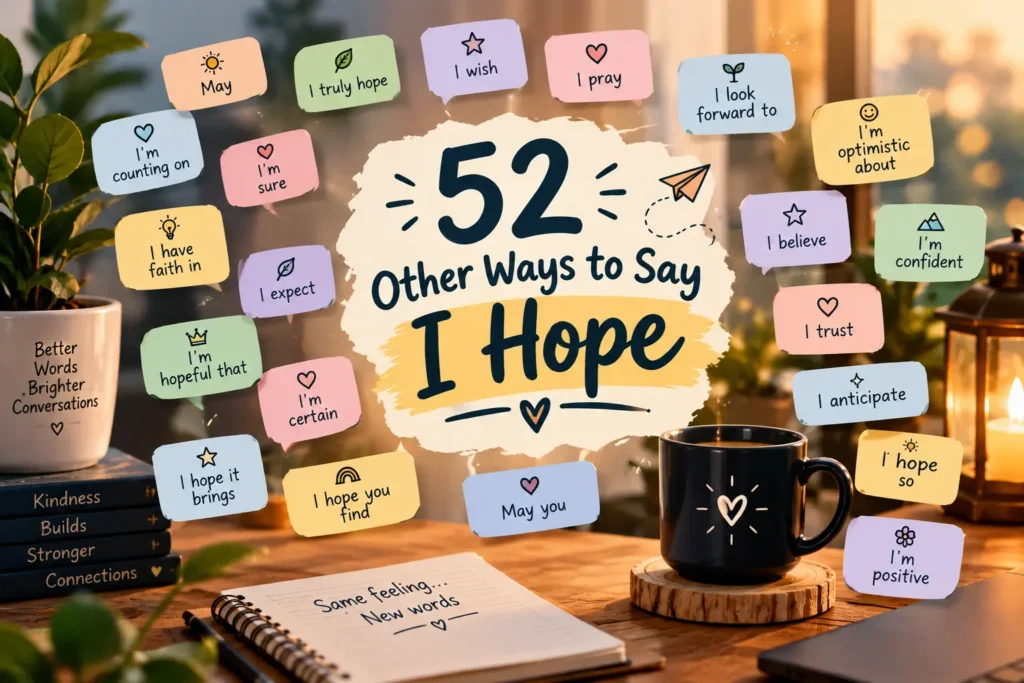
The phrase “I hope” is one of the most common ways to express wishes, expectations, possibilities, or positive thoughts in English. It works well in everyday conversations, emails, messages, and professional communication. However, using the same phrase repeatedly can make your English sound predictable.
Fortunately, there are many natural alternatives to “I hope.” Depending on the situation, you can express optimism, make a polite wish, show concern, or communicate an expectation in a more interesting way. Some alternatives sound casual and friendly, while others are better suited to professional or formal situations.
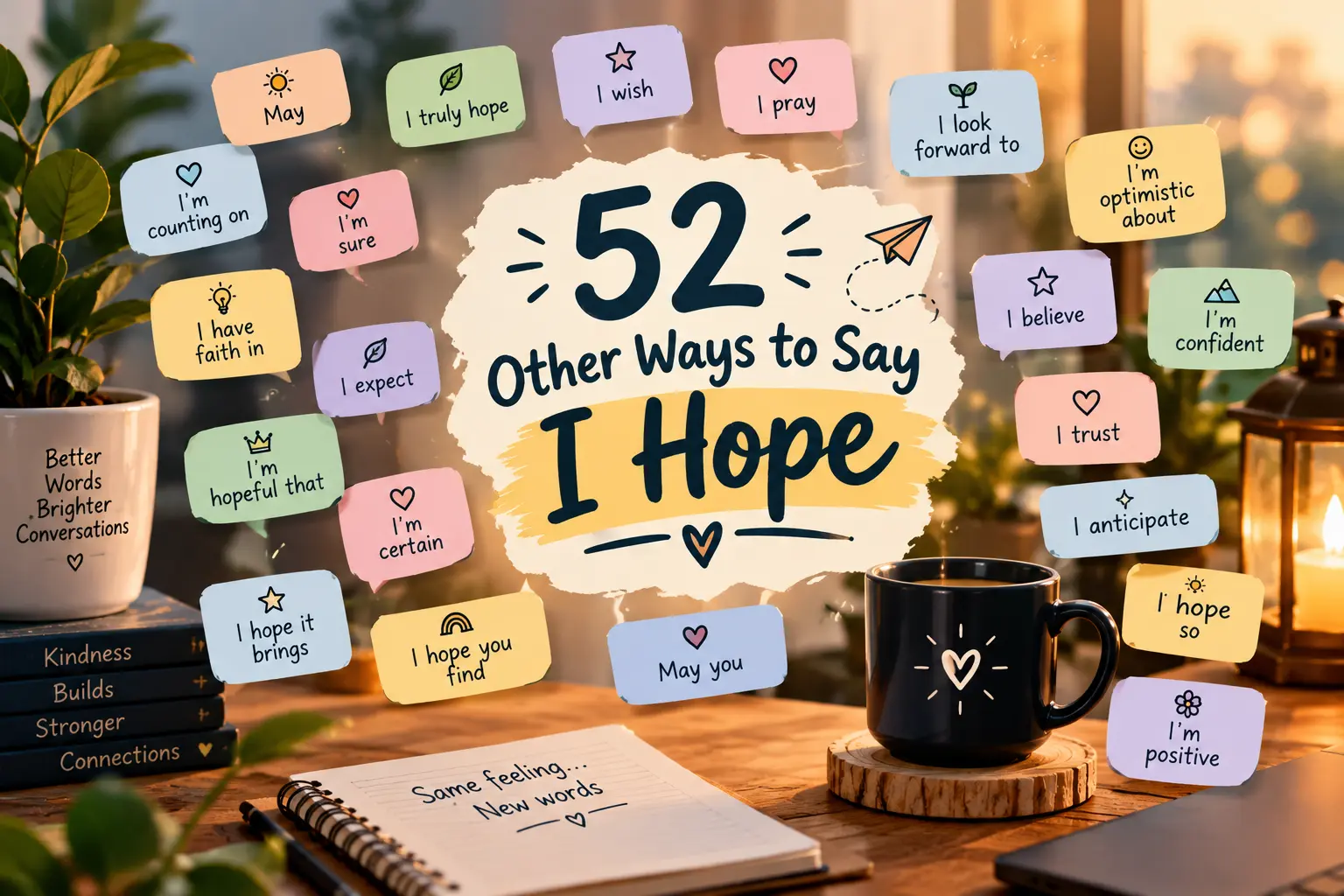
In this guide, you’ll find 52 other ways to say “I hope”, along with meanings, usage tips, and examples. These expressions can help you make your spoken and written English more natural and flexible.
When Should You Use These Alternatives?
You can replace “I hope” when you want to:
- Express a positive wish about someone’s future or situation.
- Show that you expect something good to happen.
- Make a polite statement in an email or conversation.
- Express optimism without sounding repetitive.
- Show concern or genuine interest in someone.
- Make your writing sound more formal, thoughtful, or creative.
Important: Not every alternative has exactly the same meaning as “I hope.” Some express stronger confidence, while others communicate a wish, expectation, possibility, or polite desire. Choose the phrase that best matches your intended meaning.
52 Other Ways to Say “I Hope”
1. I Wish
Meaning / Definition: “I wish” expresses a desire for something to happen or be true.
Usage: Use it when talking about something you would like to happen, especially when the situation may be uncertain or difficult.
💡 Tip: “I wish” can sometimes suggest that something is unlikely or impossible.
Examples:
- I wish you all the best in your new job.
- I wish everything goes well for you.
- I wish you a safe journey.
- I wish things were easier for everyone.
2. I’m Hoping
Meaning / Definition: “I’m hoping” expresses an active or current expectation.
Usage: It is common in everyday conversation when you are waiting for a particular result.
💡 Tip: “I’m hoping” often sounds slightly more conversational than “I hope.”
Examples:
- I’m hoping you can join us tonight.
- I’m hoping everything works out.
- I’m hoping to hear from them soon.
- I’m hoping the weather improves tomorrow.
3. Hopefully
Meaning / Definition: “Hopefully” means that you want or expect something positive to happen.
Usage: It can introduce a positive expectation or wish.
💡 Tip: “Hopefully” is especially useful when you want a short and natural alternative.
Examples:
- Hopefully, everything will be ready tomorrow.
- Hopefully, we’ll get there on time.
- Hopefully, she feels better soon.
- Hopefully, things will improve.
4. I Trust
Meaning / Definition: “I trust” expresses confidence that something will happen or be handled properly.
Usage: It is particularly useful in professional or formal communication.
💡 Tip: “I trust” sounds more confident than “I hope.”
Examples:
- I trust you’ll find this information useful.
- I trust everything is going well.
- I trust you’ll understand my position.
- I trust the matter will be resolved soon.
5. I’m Looking Forward to
Meaning / Definition: This phrase expresses positive anticipation about something that is expected to happen.
Usage: Use it when you are excited or pleased about a future event.
💡 Tip: It is especially common in professional emails.
Examples:
- I’m looking forward to hearing from you.
- I’m looking forward to meeting you.
- I’m looking forward to your response.
- I’m looking forward to working together.
6. I’d Like to Think
Meaning / Definition: “I’d like to think” expresses a hopeful or optimistic belief.
Usage: Use it when you want to express optimism without claiming certainty.
💡 Tip: This phrase sounds thoughtful and slightly cautious.
Examples:
- I’d like to think everything will work out.
- I’d like to think we made the right decision.
- I’d like to think they’ll understand.
- I’d like to think better days are ahead.
7. I’m Optimistic That
Meaning / Definition: This phrase directly communicates confidence about a positive future result.
Usage: Use it in professional, academic, or serious conversations.
💡 Tip: It sounds stronger and more confident than “I hope.”
Examples:
- I’m optimistic that we’ll reach our goal.
- I’m optimistic that things will improve.
- I’m optimistic that the project will succeed.
- I’m optimistic that we’ll find a solution.
8. I’m Confident That
Meaning / Definition: “I’m confident that” shows strong belief that something will happen.
Usage: Use it when you have good reasons to expect a particular result.
💡 Tip: Avoid it when you genuinely feel uncertain because it communicates considerable confidence.
Examples:
- I’m confident that you’ll succeed.
- I’m confident that we can solve this issue.
- I’m confident that the plan will work.
- I’m confident that everything will be fine.
9. I’m Positive That
Meaning / Definition: This expression shows strong confidence about an expected result.
Usage: Use it when you feel almost certain about something.
💡 Tip: It is stronger than simply saying “I hope.”
Examples:
- I’m positive that you’ll enjoy the experience.
- I’m positive that everything will work out.
- I’m positive that we’ll find an answer.
- I’m positive that she’ll understand.
10. I’m Expecting
Meaning / Definition: “I’m expecting” indicates that you believe something is likely to happen.
Usage: Use it when there is a reasonable basis for your expectation.
💡 Tip: It can sound more factual than emotional.
Examples:
- I’m expecting good news soon.
- I’m expecting the package tomorrow.
- I’m expecting things to improve.
- I’m expecting a positive response.
11. I Anticipate
Meaning / Definition: “I anticipate” means to expect something to happen.
Usage: It is common in formal, professional, and academic English.
💡 Tip: This is a polished alternative for business writing.
Examples:
- I anticipate a positive outcome.
- I anticipate that the project will succeed.
- I anticipate hearing from you soon.
- I anticipate further improvements.
12. I’m Counting On
Meaning / Definition: “I’m counting on” means you strongly expect someone or something to come through.
Usage: Use it when you are relying on a person or result.
💡 Tip: It communicates more dependence than “I hope.”
Examples:
- I’m counting on you to help me.
- I’m counting on everything going smoothly.
- I’m counting on your support.
- I’m counting on seeing you there.
13. I Have High Hopes
Meaning / Definition: This phrase means you feel very positive about a possible future result.
Usage: Use it when you have strong optimism.
💡 Tip: It works well when talking about goals, projects, or people.
Examples:
- I have high hopes for this project.
- I have high hopes for your future.
- We have high hopes for the new program.
- She has high hopes of winning.
14. I’m Keeping My Fingers Crossed
Meaning / Definition: This idiom expresses hope that something will have a positive outcome.
Usage: It is informal and friendly.
💡 Tip: Use it in casual conversations rather than formal business writing.
Examples:
- I’m keeping my fingers crossed for your interview.
- I’m keeping my fingers crossed that you get the job.
- We’re keeping our fingers crossed for good news.
- I’m keeping my fingers crossed for tomorrow.
15. I’m Rooting for You
Meaning / Definition: “I’m rooting for you” means you are supporting someone and want them to succeed.
Usage: Use it when encouraging a friend, colleague, teammate, or family member.
💡 Tip: It sounds warm, supportive, and conversational.
Examples:
- I’m rooting for you in the competition.
- I’m rooting for you to get the promotion.
- We’re all rooting for you.
- I’ll be rooting for you tomorrow.
16. I’m Wishing You
Meaning / Definition: “I’m wishing you” introduces a positive wish for someone.
Usage: It is useful for personal messages, greetings, and special occasions.
💡 Tip: Follow it with something positive, such as “success” or “happiness.”
Examples:
- I’m wishing you a wonderful weekend.
- I’m wishing you great success.
- I’m wishing you a safe journey.
- I’m wishing you all the best.
17. I Pray That
Meaning / Definition: “I pray that” expresses a deeply felt wish or hope.
Usage: It is often used in emotional, serious, or religious contexts.
💡 Tip: Because of its religious association, consider the context before using it.
Examples:
- I pray that everything works out.
- I pray that you stay safe.
- I pray that you find peace.
- I pray that better days are ahead.
18. I’m Hoping For the Best
Meaning / Definition: This phrase means you are staying positive despite uncertainty.
Usage: Use it when you do not know what will happen but want a good result.
💡 Tip: It is natural when discussing uncertain situations.
Examples:
- We don’t know the results yet, but I’m hoping for the best.
- I’m hoping for the best with the new project.
- She’s hoping for the best.
- We’re hoping for the best outcome.
19. I’m Crossing My Fingers
Meaning / Definition: This is another informal way to express hope for good luck or a positive result.
Usage: Use it in casual conversations and messages.
💡 Tip: “Keeping my fingers crossed” is the more common form.
Examples:
- I’m crossing my fingers for you.
- I’m crossing my fingers that we get good news.
- We’re crossing our fingers for tomorrow.
- I’m crossing my fingers that everything works.
20. Let’s Hope
Meaning / Definition: “Let’s hope” expresses a shared wish or positive expectation.
Usage: Use it when you and another person want the same positive outcome.
💡 Tip: It sounds natural and conversational.
Examples:
- Let’s hope the weather stays nice.
- Let’s hope everything goes according to plan.
- Let’s hope we get there on time.
- Let’s hope the problem is solved soon.
21. Here’s Hoping
Meaning / Definition: “Here’s hoping” is an informal expression meaning “I hope this happens.”
Usage: It is often used in casual speech or writing.
💡 Tip: It can sound upbeat and slightly playful.
Examples:
- Here’s hoping everything goes well.
- Here’s hoping for good news.
- Here’s hoping we get the result we want.
- Here’s hoping tomorrow is better.
22. I’m Praying For
Meaning / Definition: This phrase communicates a strong emotional or spiritual wish for someone or something.
Usage: It is often used when someone is facing a difficult situation.
💡 Tip: Use it when the emotional or religious context is appropriate.
Examples:
- I’m praying for your recovery.
- I’m praying for your family.
- I’m praying for a positive outcome.
- We’re praying for everyone’s safety.
23. I’d Love to See
Meaning / Definition: “I’d love to see” expresses a strong personal desire for something to happen.
Usage: Use it when talking about a future situation you would enjoy.
💡 Tip: It sounds warmer and more personal than “I hope.”
Examples:
- I’d love to see you succeed.
- I’d love to see this project grow.
- I’d love to see everyone together again.
- I’d love to see things improve.
24. I’d Be Happy If
Meaning / Definition: This phrase expresses a positive desire for a particular situation.
Usage: Use it when describing something that would make you pleased.
💡 Tip: It is useful when making polite requests or expressing preferences.
Examples:
- I’d be happy if you could join us.
- I’d be happy if everything worked out.
- I’d be happy if we could meet soon.
- I’d be happy if you accepted the offer.
25. I’m Looking to
Meaning / Definition: “I’m looking to” can express an intention or desired future outcome.
Usage: Use it when you are actively trying to achieve something.
💡 Tip: It is better for intentions than simple wishes.
Examples:
- I’m looking to improve my English.
- I’m looking to build a stronger team.
- I’m looking to find a better solution.
- I’m looking to make progress this year.
26. I’m Trusting That
Meaning / Definition: “I’m trusting that” expresses a hopeful belief that something will happen.
Usage: It works well when you want to show confidence while acknowledging uncertainty.
💡 Tip: It can sound thoughtful and reassuring.
Examples:
- I’m trusting that everything will work out.
- I’m trusting that you’ll understand.
- I’m trusting that things will improve.
- I’m trusting that we’re making progress.
27. I’m Expectant That
Meaning / Definition: This phrase communicates an expectation about a future result.
Usage: It is less common in everyday English and should be used carefully.
💡 Tip: “I expect” or “I’m expecting” is usually more natural.
Examples:
- I’m expectant of a positive result.
- She is expectant of good news.
- They are expectant of success.
- He remained expectant of a favorable outcome.
28. I’m Holding Out Hope
Meaning / Definition: This means continuing to believe that something positive may still happen.
Usage: Use it when a situation is uncertain or difficult.
💡 Tip: It often suggests that the outcome is not guaranteed.
Examples:
- I’m holding out hope that they’ll return.
- We’re holding out hope for good news.
- She’s holding out hope for a solution.
- I’m still holding out hope that things will change.
29. I’m Staying Hopeful
Meaning / Definition: This phrase means maintaining a positive attitude despite uncertainty.
Usage: Use it when you want to emphasize optimism.
💡 Tip: It works particularly well in difficult circumstances.
Examples:
- I’m staying hopeful about the future.
- We’re staying hopeful that things improve.
- She’s staying hopeful despite the setback.
- I’m staying hopeful for a positive result.
30. I Remain Hopeful
Meaning / Definition: “I remain hopeful” means you continue to believe that something positive may happen.
Usage: It is more formal than “I’m staying hopeful.”
💡 Tip: This phrase works well in professional or serious writing.
Examples:
- I remain hopeful that we can find a solution.
- I remain hopeful about the future.
- We remain hopeful for a positive outcome.
- I remain hopeful that an agreement can be reached.
31. I’m Hopeful That
Meaning / Definition: This phrase directly communicates optimism about a future event.
Usage: Use it in both casual and professional situations.
💡 Tip: It is one of the closest natural alternatives to “I hope.”
Examples:
- I’m hopeful that everything will work out.
- I’m hopeful that you’ll enjoy the experience.
- I’m hopeful that we can reach an agreement.
- I’m hopeful that things will improve soon.
32. I’m Positive About
Meaning / Definition: “I’m positive about” expresses an optimistic attitude toward something.
Usage: Use it when discussing your general outlook rather than one specific event.
💡 Tip: “Positive about” can refer to a situation, decision, plan, or future.
Examples:
- I’m positive about our chances.
- I’m positive about the future.
- She’s positive about the new opportunity.
- We’re positive about the direction of the project.
33. I Have Faith That
Meaning / Definition: This phrase means you strongly believe that something good will happen.
Usage: It can be emotional, inspirational, personal, or spiritual.
💡 Tip: It communicates stronger belief than a simple hope.
Examples:
- I have faith that everything will work out.
- I have faith that you’ll succeed.
- We have faith that better days are coming.
- She has faith that things will improve.
34. I Believe
Meaning / Definition: “I believe” expresses personal confidence or conviction about something.
Usage: Use it when you want to communicate belief rather than uncertainty.
💡 Tip: Add “that” followed by the expected result when needed.
Examples:
- I believe everything will be fine.
- I believe you’ll do well.
- I believe things will improve.
- I believe we can solve this.
35. I’m Sure
Meaning / Definition: “I’m sure” expresses confidence that something is true or will happen.
Usage: Use it when you have a strong expectation.
💡 Tip: It is more confident than “I hope.”
Examples:
- I’m sure everything will be okay.
- I’m sure you’ll enjoy the trip.
- I’m sure she’ll understand.
- I’m sure things will get better.
36. I’m Confident
Meaning / Definition: “I’m confident” communicates a strong belief in a positive outcome.
Usage: Use it when you have evidence, experience, or a strong reason for your belief.
💡 Tip: It is especially useful in professional communication.
Examples:
- I’m confident we’ll succeed.
- I’m confident you’ll make the right choice.
- I’m confident the plan will work.
- I’m confident we can meet the deadline.
37. May
Meaning / Definition: “May” can introduce a formal wish or blessing.
Usage: It is commonly used in greetings, speeches, cards, and formal messages.
💡 Tip: This is a more elegant alternative to directly saying “I hope.”
Examples:
- May you have a wonderful year.
- May everything go well for you.
- May your dreams come true.
- May you find happiness and success.
38. Wishing You
Meaning / Definition: “Wishing you” expresses a warm and positive desire for someone’s future.
Usage: Use it in messages, emails, cards, and greetings.
💡 Tip: It works especially well with phrases such as “all the best” and “continued success.”
Examples:
- Wishing you all the best.
- Wishing you a successful year.
- Wishing you a safe trip.
- Wishing you happiness and peace.
39. Best Wishes for
Meaning / Definition: “Best wishes for” expresses a positive hope or blessing for a specific event or period.
Usage: It is common in cards, messages, and professional communication.
💡 Tip: Keep the phrase focused on a specific occasion.
Examples:
- Best wishes for your new job.
- Best wishes for your future.
- Best wishes for a successful event.
- Best wishes for your upcoming journey.
40. All the Best
Meaning / Definition: “All the best” is a concise way to wish someone success, happiness, or good results.
Usage: It is common in friendly and professional communication.
💡 Tip: It is especially useful as an email or message closing.
Examples:
- All the best with your new job.
- All the best for your exam.
- All the best for the future.
- All the best with everything.
41. Fingers Crossed
Meaning / Definition: “Fingers crossed” is a short informal expression of hope.
Usage: Use it in casual speech, texts, and social media.
💡 Tip: It is concise and friendly.
Examples:
- Fingers crossed for good news.
- Fingers crossed everything goes well.
- Fingers crossed you get the job.
- Fingers crossed for tomorrow.
42. Let’s Keep Our Hopes Up
Meaning / Definition: This phrase encourages people to remain optimistic.
Usage: Use it when a situation is uncertain but there is still reason for optimism.
💡 Tip: It emphasizes shared encouragement.
Examples:
- Let’s keep our hopes up until we hear back.
- Let’s keep our hopes up for a positive result.
- We should keep our hopes up.
- Let’s keep our hopes up and stay positive.
43. I’m Keeping Hope Alive
Meaning / Definition: This expression means you continue to believe that a positive result is possible.
Usage: It is usually informal and expressive.
💡 Tip: It can sound motivational or emotional.
Examples:
- I’m keeping hope alive until the final decision.
- She’s keeping hope alive.
- We’re keeping hope alive for a better outcome.
- I’m keeping hope alive despite the challenges.
44. I’m Looking on the Bright Side
Meaning / Definition: This means focusing on positive possibilities instead of negative ones.
Usage: Use it when trying to remain optimistic in a difficult situation.
💡 Tip: It does not directly mean “I hope,” but it can communicate a hopeful attitude.
Examples:
- I’m looking on the bright side and staying positive.
- We’re looking on the bright side of things.
- She’s looking on the bright side despite the delay.
- I’m trying to look on the bright side.
45. I’m Positive Things Will
Meaning / Definition: This phrase introduces a confident expectation that something will improve or happen.
Usage: Complete it with a suitable verb phrase.
💡 Tip: Use it when you want to sound optimistic rather than uncertain.
Examples:
- I’m positive things will get better.
- I’m positive things will work out.
- I’m positive things will improve soon.
- I’m positive things will change for the better.
46. I’m Expecting Good Things
Meaning / Definition: This phrase communicates an optimistic expectation about the future.
Usage: Use it when you believe positive developments are likely.
💡 Tip: It works well in casual and motivational conversations.
Examples:
- I’m expecting good things from this opportunity.
- I’m expecting good things this year.
- We’re expecting good things from the new project.
- She’s expecting good things ahead.
47. I’m Looking Forward to Good News
Meaning / Definition: This phrase expresses anticipation for a positive update or result.
Usage: Use it when waiting for information or a decision.
💡 Tip: It sounds polite and positive in emails.
Examples:
- I’m looking forward to good news.
- We’re looking forward to hearing some good news.
- I’m looking forward to positive news from the team.
- She’s looking forward to good news tomorrow.
48. I’m Hoping That
Meaning / Definition: “I’m hoping that” is a natural variation of “I hope that.”
Usage: Use it when describing a current wish or expectation.
💡 Tip: It sounds conversational and natural in everyday English.
Examples:
- I’m hoping that you can come.
- I’m hoping that everything goes smoothly.
- I’m hoping that we hear back soon.
- I’m hoping that she feels better.
49. I’m Wishing That
Meaning / Definition: “I’m wishing that” describes a desire for something to happen or change.
Usage: It can be used in personal or reflective situations.
💡 Tip: In many everyday situations, “I wish” or “I’m hoping” sounds more natural.
Examples:
- I’m wishing that things were different.
- I’m wishing that you were here.
- I’m wishing that everything could work out.
- I’m wishing that we had more time.
50. I’m Looking for a Positive Outcome
Meaning / Definition: This phrase expresses a desire or expectation for a favorable result.
Usage: It works well in professional and formal contexts.
💡 Tip: It sounds more objective than “I hope.”
Examples:
- I’m looking for a positive outcome from the discussion.
- We’re looking for a positive outcome.
- I’m looking for a positive outcome for everyone involved.
- The team is looking for a positive outcome.
51. I’m Hoping for the Best
Meaning / Definition: This means you want the situation to have the best possible result despite uncertainty.
Usage: Use it when you cannot predict exactly what will happen.
💡 Tip: It is one of the most natural alternatives for difficult or uncertain situations.
Examples:
- I don’t know what will happen, but I’m hoping for the best.
- We’re hoping for the best after the interview.
- She’s hoping for the best with her application.
- I’m hoping for the best and preparing for anything.
52. I Hope Things Work Out
Meaning / Definition: This phrase expresses a general wish that a difficult or uncertain situation will have a positive result.
Usage: Use it when someone is dealing with a change, problem, decision, or uncertain future.
💡 Tip: It is warm, natural, and especially common in supportive conversations.
Examples:
- I hope things work out for you.
- I really hope things work out.
- We all hope things work out in the end.
- I hope things work out the way you want.
Bonus: Short & Casual Ways to Say “I Hope”
When texting friends or chatting casually, you can use shorter expressions instead of repeating “I hope.”
- Hopefully!
- Fingers crossed!
- Let’s hope so!
- Here’s hoping!
- I’m rooting for you!
- Best of luck!
- Wishing you the best!
- Keeping my fingers crossed!
- Hope it works out!
- Hope for the best!
These expressions are especially useful in text messages, social media conversations, and casual chats.
Formal Ways to Say “I Hope”
For professional emails, business communication, or formal writing, consider these alternatives:
- I trust that…
- I anticipate that…
- I remain hopeful that…
- I am optimistic that…
- I am confident that…
- I look forward to…
- I would be pleased if…
- I sincerely wish that…
- I am hopeful that…
- I look forward to a positive outcome.
For example, instead of writing “I hope you will respond soon,” you could write “I look forward to your response.” This sounds more polished and professional.
Final Tips for Using Alternatives to “I Hope”
- Use “I’m hoping” when you want to sound natural and conversational.
- Use “hopefully” for a short and flexible expression of positive expectation.
- Use “I trust” when you want to sound confident and professional.
- Use “I’m optimistic that” when you want to emphasize a positive outlook.
- Use “fingers crossed” or “I’m rooting for you” in casual conversations.
- Use “I look forward to” when discussing something you expect or anticipate in professional communication.
- Remember that “I wish” can sometimes suggest an unreal, unlikely, or impossible situation, so it is not always interchangeable with “I hope.”
Choosing the right alternative depends on your relationship with the listener, the situation, and how confident or emotional you want to sound. Once you understand these differences, you can make your English more natural, expressive, and varied without relying on “I hope” in every sentence.