
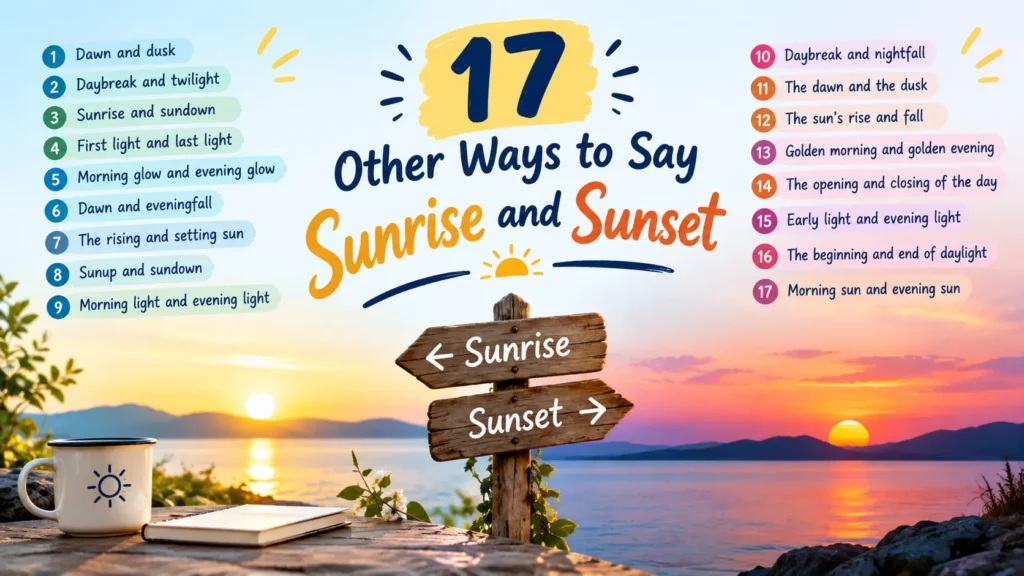
Sunrise and sunset are simple words, but they do not always capture the exact feeling, time of day, or image you want to describe. Whether you are writing about a beautiful morning, describing a landscape, or creating a thoughtful social media caption, choosing a more specific expression can make your English sound more natural and expressive.
Knowing other ways to say “sunrise and sunset” is especially useful in 2026 because strong communication often depends on choosing words that fit the situation. Students can use these expressions to improve their vocabulary, professionals can make descriptive writing more polished, and ESL learners can sound more confident when speaking or writing in English. The alternatives below range from simple everyday expressions to more creative and literary choices.
When Should You Use These Alternatives?
Different alternatives work better depending on your audience, purpose, and the feeling you want to create.
- Casual conversations: Use simple expressions such as “sunup,” “sundown,” “dawn,” or “dusk” when talking naturally with friends or family.
- Professional situations: Choose clear terms such as “daybreak,” “first light,” “sunrise,” or “sunset” when writing reports, schedules, travel information, or professional messages.
- Academic writing: Use precise expressions such as “dawn,” “daybreak,” “sunrise,” and “nightfall” when describing time, geography, literature, or natural phenomena.
- Emails and messages: Short expressions such as “at dawn” or “around sunset” are useful when arranging plans or describing an event.
- Social media posts: More creative phrases such as “morning glow,” “evening glow,” or “the rising sun” can make captions more vivid and engaging.
- Public speaking: Descriptive phrases such as “the first light of day” or “the setting sun” can help create a stronger mental image for your audience.
⚠️ Warning: Not every alternative is a direct replacement in every sentence. Some expressions describe a specific part of sunrise or sunset, while others are more poetic or informal, so always consider the context before using them.
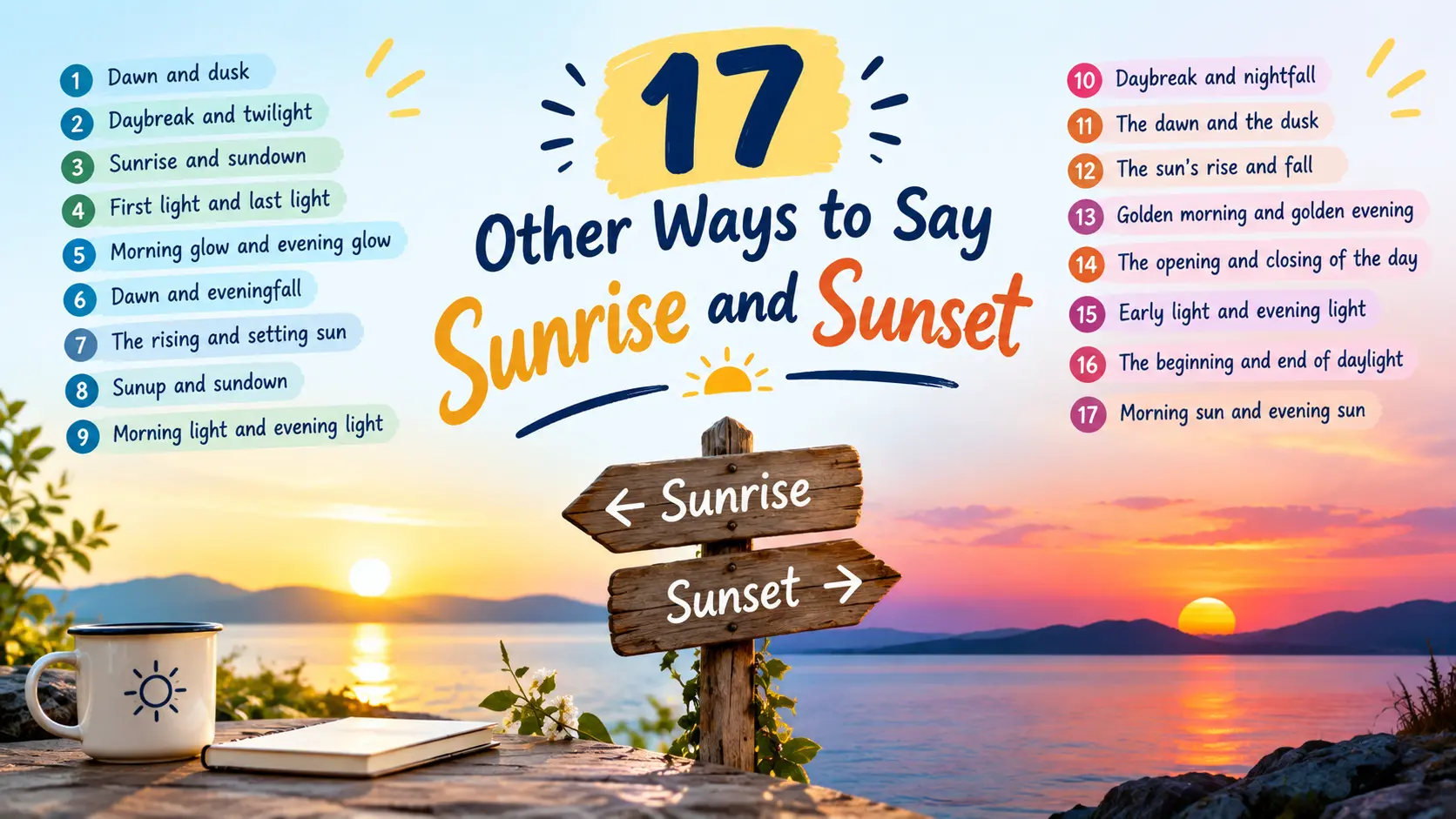
17 Other Ways to Say “Sunrise and Sunset”
1. Dawn
Meaning / Definition
Dawn refers to the early part of the day when daylight first begins to appear. It is closely associated with sunrise but can refer to the period before the sun actually rises.
Usage
Use “dawn” in casual, academic, and formal writing when describing the beginning of daylight. It is also common in literary or descriptive English and sounds slightly more elegant than simply saying “sunrise.”
💡 Tip
Use “at dawn” when you mean very early in the morning rather than the exact moment the sun appears.
Examples
- We left the campsite at dawn to begin our hike.
- Birds started singing at the first signs of dawn.
- The village looked peaceful in the soft light of dawn.
- The researchers began their observations before dawn.
2. Dusk
Meaning / Definition
Dusk is the period when daylight is fading after the sun has gone down. It describes the transition from daylight toward nighttime.
Usage
Use “dusk” when talking about the evening period around and after sunset. It works well in everyday speech, descriptive writing, and stories.
💡 Tip
Remember that dawn belongs to the morning, while dusk belongs to the evening.
Examples
- We reached the lake just before dusk.
- The streets became quieter as dusk settled over the town.
- They enjoyed a picnic until dusk.
- The mountains looked purple in the fading light of dusk.
3. Daybreak
Meaning / Definition
Daybreak means the time when a new day begins and daylight starts becoming visible. It is another natural way to describe the early light around sunrise.
Usage
Use “daybreak” in both spoken and written English when you want to emphasize the beginning of a new day. It is semi-formal and works particularly well in descriptions of travel, nature, or early activities.
💡 Tip
“Daybreak” is a good choice when the focus is on the arrival of daylight rather than the sun itself.
Examples
- The fishermen returned to shore shortly after daybreak.
- We started driving at daybreak to avoid heavy traffic.
- A pale blue sky appeared at daybreak.
- The hikers reached the summit before daybreak.
4. Nightfall
Meaning / Definition
Nightfall refers to the time when darkness arrives and the day changes into night. It is generally associated with the period after sunset.
Usage
Use “nightfall” when describing the arrival of darkness, especially in stories, travel writing, or formal descriptions. It is more descriptive than simply saying “sunset.”
💡 Tip
Use “nightfall” when the important idea is darkness arriving, not the sun disappearing below the horizon.
Examples
- We needed to reach the cabin before nightfall.
- The temperature dropped quickly after nightfall.
- The animals became more active at nightfall.
- They lit a fire as nightfall approached.
5. First Light
Meaning / Definition
“First light” refers to the earliest visible daylight before or around sunrise. It creates an image of the first brightness appearing in the sky.
Usage
This phrase is common in descriptive, professional, and outdoor contexts. It is semi-formal and is especially useful when describing an early start.
💡 Tip
Use “first light” when you want to focus on the appearance of brightness rather than the sun itself.
Examples
- We began our climb at first light.
- The photographer arrived at the beach before first light.
- The landscape slowly appeared at first light.
- Farmers were already working by first light.
6. Last Light
Meaning / Definition
“Last light” describes the final natural daylight before darkness takes over. It often refers to the soft light that remains around sunset.
Usage
Use this phrase in photography, outdoor conversations, travel writing, and descriptive prose. It is semi-formal and can sound more atmospheric than simply saying “sunset.”
💡 Tip
“Last light” is especially useful when describing the final moments of daylight.
Examples
- We took our final photographs in the last light of the day.
- The mountains glowed under the last light.
- The hikers reached camp in the last light.
- She watched the birds flying across the sky in the last light.
7. Sunup
Meaning / Definition
“Sunup” is an informal word for the time when the sun rises. It is a simple alternative to “sunrise.”
Usage
Use “sunup” mainly in casual conversations and informal writing. It can sound friendly and conversational but is less suitable for formal academic or professional documents.
💡 Tip
Choose “sunup” when you want your sentence to sound relaxed and natural.
Examples
- We need to leave before sunup.
- He goes fishing around sunup on weekends.
- The field was covered in mist at sunup.
- They watched the sky change colors at sunup.
8. Sundown
Meaning / Definition
“Sundown” is an informal term for the time when the sun sets and daylight begins to disappear. It is commonly used to describe the end of the daylight hours.
Usage
Use “sundown” in casual conversation, travel writing, and informal descriptions. It can also appear in creative writing when a relaxed or traditional tone is desired.
💡 Tip
“Sundown” sounds more conversational than “sunset,” so consider your audience before using it in formal writing.
Examples
- The park closes shortly after sundown.
- We sat outside until sundown.
- The temperature became cooler after sundown.
- They returned home before sundown.
9. The Rising Sun
Meaning / Definition
“The rising sun” describes the sun as it moves above the horizon in the morning. The phrase emphasizes the movement and appearance of the sun rather than simply naming the time.
Usage
Use it in descriptive, creative, travel, and conversational writing. It is semi-formal and works particularly well when you want readers to visualize a morning scene.
💡 Tip
Use “the rising sun” when the sun itself is an important part of your description.
Examples
- The rising sun illuminated the valley.
- We watched the rising sun from the rooftop.
- The rising sun turned the clouds golden.
- She opened the curtains to welcome the rising sun.
10. The Setting Sun
Meaning / Definition
“The setting sun” describes the sun as it moves toward or below the horizon in the evening. It focuses on the visible sun and the process of sunset.
Usage
Use this expression in descriptive, creative, travel, and literary writing. It is semi-formal and often creates a calm or scenic image.
💡 Tip
Choose “the setting sun” when you want to describe what the sun looks like rather than simply referring to the time of day.
Examples
- The setting sun reflected across the ocean.
- We watched the setting sun from the hilltop.
- The setting sun painted the clouds orange.
- Photographers gathered to capture the setting sun.
11. Morning Glow
Meaning / Definition
“Morning glow” refers to the soft, warm light and colors that can appear in the sky around sunrise. It is a descriptive phrase rather than an exact scientific term.
Usage
Use it in creative writing, social media captions, travel descriptions, and casual conversations. It has a warm, expressive tone and is less appropriate when precise timing is important.
💡 Tip
Use “morning glow” when you want to emphasize the beauty or atmosphere of early daylight.
Examples
- The morning glow made the lake look golden.
- She took a photograph of the mountains in the morning glow.
- The morning glow filled the room through the window.
- We enjoyed our coffee while watching the morning glow.
12. Evening Glow
Meaning / Definition
“Evening glow” describes the soft light and warm colors that often appear in the sky around sunset. It focuses more on the atmosphere and colors than the exact moment of sunset.
Usage
Use it in creative, conversational, travel, and social media writing. It has a warm and slightly poetic tone.
💡 Tip
“Evening glow” is useful when describing the colors surrounding sunset rather than the sunset itself.
Examples
- The evening glow reflected beautifully on the water.
- We sat on the balcony and enjoyed the evening glow.
- The buildings looked golden in the evening glow.
- Her photograph captured the soft evening glow perfectly.
13. Break of Day
Meaning / Definition
“Break of day” is a traditional expression for the beginning of daylight. It refers to the early morning when night gives way to a new day.
Usage
Use this phrase in storytelling, descriptive writing, and literary contexts. It is less common in everyday modern conversation, so it can give your writing a more expressive or traditional feel.
💡 Tip
Use “break of day” when you want your sentence to sound vivid or slightly literary.
Examples
- The travelers set off at the break of day.
- Mist covered the fields at the break of day.
- We could hear birds calling at the break of day.
- The old bridge appeared through the fog at the break of day.
14. Close of Day
Meaning / Definition
“Close of day” refers to the end of the daylight period and, in some contexts, the end of the working day. It does not always mean the exact moment of sunset.
Usage
This expression is most useful in professional, business, and formal communication. It is semi-formal and can refer to a deadline as well as the ending of daytime.
💡 Tip
In business messages, “close of day” can mean the end of the workday rather than literal sunset.
Examples
- Please send the completed report by close of day.
- The office becomes quiet toward the close of day.
- We returned to the hotel at the close of day.
- The final boats came back toward the close of day.
15. The First Rays of Sunlight
Meaning / Definition
“The first rays of sunlight” describes the earliest beams of sunlight appearing in the morning. It creates a visual image of sunlight reaching the landscape.
Usage
Use this phrase in descriptive, creative, travel, and literary writing. It is more expressive than simply saying “sunrise” and works best when describing a scene.
💡 Tip
Choose this phrase when you want your reader to imagine sunlight spreading across a place.
Examples
- The first rays of sunlight reached the quiet village.
- We watched the first rays of sunlight appear over the mountains.
- The flowers opened beneath the first rays of sunlight.
- The first rays of sunlight entered through the bedroom window.
16. The Fading Daylight
Meaning / Definition
“The fading daylight” describes natural light becoming weaker as evening approaches. It is associated with sunset but focuses on the gradual loss of light.
Usage
Use this expression in descriptive and creative writing when you want to emphasize the transition from day to evening. It is semi-formal and sounds natural when describing landscapes or outdoor scenes.
💡 Tip
Use “fading daylight” when the change from light to darkness happens gradually.
Examples
- We continued walking through the fading daylight.
- The fading daylight gave the forest a mysterious appearance.
- She watched the birds disappear into the fading daylight.
- The road became harder to see in the fading daylight.
17. Twilight
Meaning / Definition
Twilight is the period of soft natural light before sunrise or after sunset when the sky is not completely dark. It can refer to either morning or evening, depending on the context.
Usage
Use “twilight” in everyday, academic, creative, and descriptive writing. It is a versatile word, but remember that it describes a period of light rather than the exact moment of sunrise or sunset.
💡 Tip
Use a phrase such as “morning twilight” or “evening twilight” when you want to make the timing completely clear.
Examples
- The city looked beautiful in the evening twilight.
- We arrived at the campsite during morning twilight.
- The birds became active during the quiet twilight.
- The photographer waited patiently for the soft colors of twilight.
H2: Bonus Section — Creative Versions
Creative alternatives can make descriptions of sunrise and sunset more vivid, especially in captions, stories, travel writing, and personal messages. These ready-to-use phrases focus on atmosphere and imagery rather than simply naming the time of day.
- “Welcoming the first light of morning.”
- “Watching the sun paint the sky.”
- “Chasing the golden hour.”
- “Saying goodbye to another day.”
- “Where daylight meets the horizon.”
- “Under the glow of a new morning.”
Final Tips — How to Choose the Right Phrase
The best alternative depends on whether you want to describe a precise time, a visual scene, or an emotional atmosphere.
- Consider the setting: Choose “sunup” or “sundown” for relaxed conversation, while “dawn” and “twilight” work well in more descriptive contexts.
- Know your audience: ESL learners should start with familiar words such as “dawn,” “dusk,” “sunrise,” and “sunset” before using more literary expressions.
- Match the formality: “Sunup” and “sundown” are informal, while “daybreak,” “first light,” and “nightfall” can work in more polished writing.
- Spoken vs written: Everyday speech often favors short, familiar terms, while creative writing gives you more freedom to use expressions such as “morning glow” or “the rising sun.”
- Cultural sensitivity: Make sure an expression is being used for its actual meaning rather than assuming every poetic phrase means exactly the same thing as sunrise or sunset.
- Emotional tone: Use warm expressions such as “evening glow” for peaceful scenes and “fading daylight” when you want a more reflective atmosphere.
- Practice naturally: Try replacing “sunrise” or “sunset” in your own sentences and check whether the new phrase keeps the meaning you intended.